AIVM Explained: How ChainGPT is Decentralising AI with a Dedicated Layer-1 Blockchain
ChainGPT is building AIVM, a purpose-built Layer-1 blockchain designed to run AI workloads without reliance on centralised corporate infrastructure. The article explains how AIVM addresses the three key bottlenecks keeping AI centralised — compute, data, and model access — through its own consensus mechanism, validator architecture, and decentralised marketplaces, with a public testnet launching in Q1–Q2 2026.
→Most DeFi protocols claiming decentralisation still depend on centralised AI APIs from companies like OpenAI, Google, and cloud providers, creating critical single points of failure.
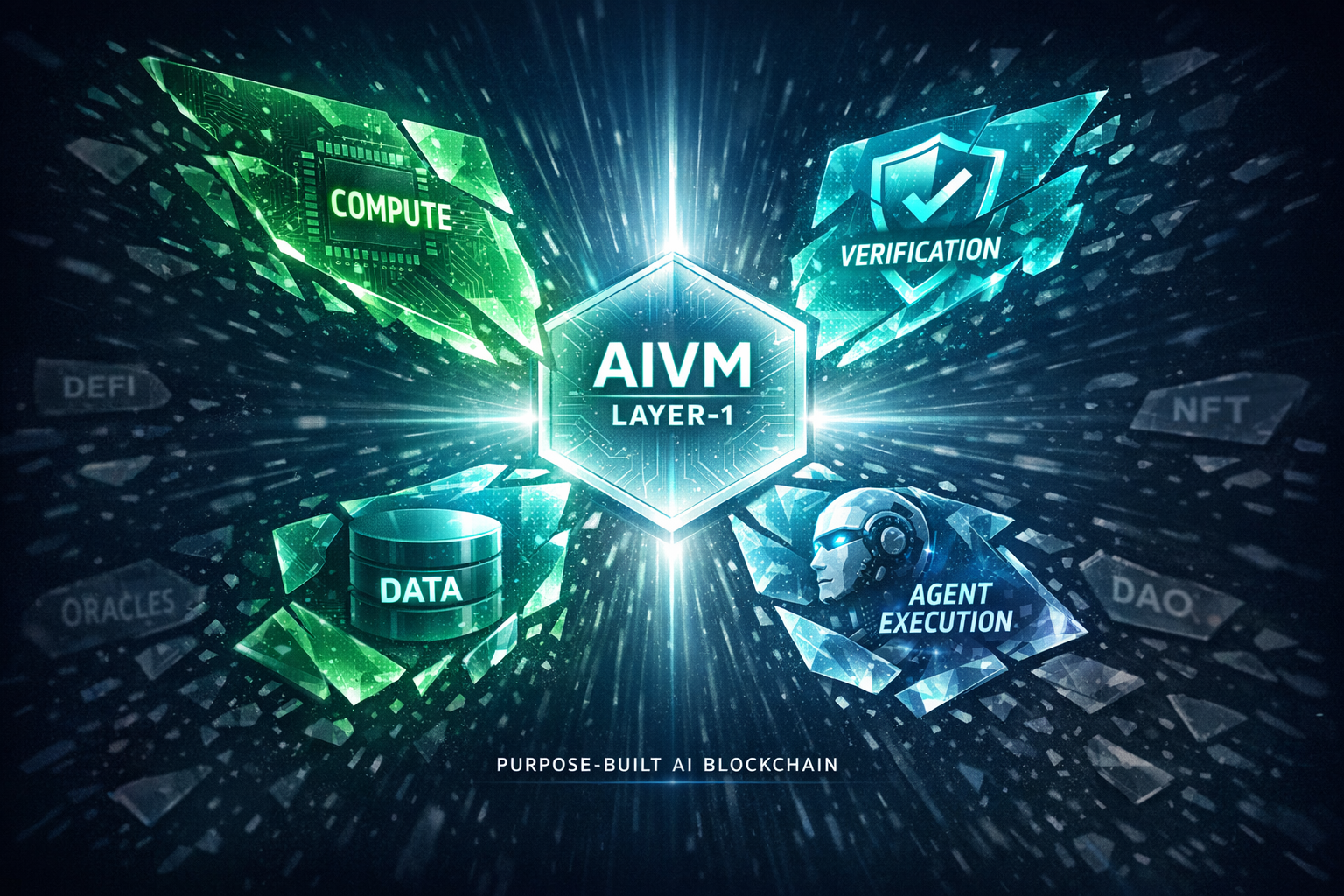
→AIVM is a dedicated Layer-1 blockchain built by ChainGPT under parent entity D3 Global, designed specifically for AI execution rather than being a general-purpose chain with AI added as an afterthought.
→The three bottlenecks keeping AI centralised are compute (GPU access), data, and model availability, all of which are currently locked behind corporate walls.
→AIVM features its own consensus mechanism, validator architecture, and built-in compute and data marketplaces to create a fully decentralised AI infrastructure.
3-5
Mega-corps controlling AI infrastructure
50-80%
Cloud provider margins on GPU compute
0
Open marketplaces for AI data with cryptographic guarantees
A growing number of DeFi protocols and Web3 applications — lending markets, perpetual exchanges, yield optimizers, AI-powered trading bots — rely on centralised AI infrastructure somewhere in their stack. A sentiment model hosted on AWS. A risk-scoring engine running on Azure. A chatbot powered by OpenAI. One policy change, one rate hike, one deprecation notice from a company in San Francisco, and applications that market themselves as permissionless face sudden dependency risks.
This isn't hypothetical. In 2024, OpenAI began sunsetting GPT-3.5 Turbo endpoints, pushing projects toward newer (and pricier) models on migration timelines they didn't control. Throughout 2024–2025, major cloud AI providers have repeatedly adjusted API pricing tiers, rate limits, and model availability — forcing startups to either absorb cost increases or degrade their products with little notice. The "decentralised" future we've been building still has a centralised brain — and somebody else controls the off switch.
The question isn't whether decentralised AI infrastructure is necessary. It's whether anyone is actually building it properly.
That's the bet behind AIVM — a purpose-built Layer-1 blockchain designed from the ground up by ChainGPT (under parent entity D3 Global, the corporate umbrella overseeing ChainGPT's suite of AI and Web3 products) to run AI workloads without corporate gatekeepers. Not a general-purpose chain with AI bolted on as an afterthought. Not a whitepaper promise. A dedicated AI execution environment with its own consensus, its own validator architecture, its own compute and data marketplaces — all powered by the $CGPT token, which already trades on major exchanges and serves as the native gas and utility token for the AIVM network.
The public testnet launched in Q1 2026 and is currently live through Q2 2026. Here's everything you need to understand about what AIVM is, how it works, and why it matters.
01
The Three Bottlenecks: Why AI Stays Centralised
AIVM illustration 1
AIVM visual 1
To understand why AIVM exists, you need to understand what makes AI expensive, exclusive, and opaque. It comes down to three scarce resources — and all three are locked behind corporate walls.
Compute. Training and running AI models requires GPUs — lots of them. Nvidia's H100s and their successors are the gold standard, and they're allocated disproportionately to hyperscalers: Microsoft, Google, Amazon, Meta. According to industry estimates, the top four cloud providers control roughly 65–75% of high-end GPU availability for AI workloads. If you're an independent developer or a mid-size company, you're either paying premium cloud rates (with margins commonly estimated at 50–80% above hardware cost) or you're waiting months for hardware allocations. The GPU supply chain is a bottleneck controlled by a handful of players.
Data. Large language models are trained on terabytes of text, images, code, and structured data. Where does this data come from? Mostly, it's scraped from the open web without consent, or it's proprietary datasets locked inside corporations. There's no open marketplace where data providers can sell access with cryptographic guarantees of privacy and provenance, and data consumers can verify quality without trusting a middleman.
Models. Even "open-weight" models like Meta's Llama require enormous infrastructure to run. Downloading weights is free; serving inference at scale is not. A single Llama 70B instance can require multiple A100 GPUs just for inference, costing thousands per month in cloud compute. And when you use a hosted model via API, you're trusting the provider not to log your inputs, change the model silently, or censor outputs. Open weights are a start, but they're not decentralised infrastructure.
Several projects have taken aim at pieces of this problem — and understanding them is essential context for evaluating AIVM's approach.
Bittensor ($TAO, ~$2.8B market cap) built an incentivised network for decentralised model training and inference through competitive ML subnets, where miners compete to produce the best model outputs and validators score quality. It's arguably the most mature decentralised model training network. Ritual is building an AI coprocessor network that brings verifiable AI inference to existing blockchains through cryptographic attestation. Gensyn focuses specifically on decentralised model training with verification, targeting the compute-intensive training phase. Akash Network and io.net both operate decentralised compute marketplaces — Akash as a general-purpose cloud alternative, io.net specifically aggregating GPU resources for AI workloads. Fetch.ai ($FET, ~$1.8B) pioneered autonomous AI agents on Cosmos, now merged into the ASI Alliance alongside Ocean Protocol ($OCEAN, ~$350M) and SingularityNET ($AGIX, ~$1.2B). Ocean focused on data marketplaces. SingularityNET built an AI services marketplace. Each tackled one or two facets of the problem.
But none of them built the unified infrastructure layer — a single chain where compute, data, model execution, privacy, and developer tooling all live natively, settled in one token, secured by one validator set purpose-built for AI workloads.
That's the gap AIVM is designed to fill.
By the numbers
3-5
Mega-corps controlling AI infrastructure
50-80%
Cloud provider margins on GPU compute
0
Open marketplaces for AI data with cryptographic guarantees
02
What AIVM Actually Is
AIVM illustration 2
AIVM visual 2
Here's the elevator pitch: AIVM is a unified Layer-1 blockchain offering decentralised compute, agent AI execution, tokenised data marketplaces, and developer tooling on a single chain.
Let's break that down.
Layer-1 means AIVM is a sovereign blockchain. It has its own consensus mechanism, its own validators, its own block production. It doesn't inherit security from Ethereum or BNB Chain the way a rollup or sidechain would. Think of it as building your own house rather than renting an apartment in someone else's building — you control the architecture, the rules, and the upgrades.
Purpose-built for AI means the chain's architecture — consensus, execution, validation, privacy — was designed around AI workloads from day one. This isn't an EVM clone with a few AI-themed smart contracts. The execution model, the validator roles, the privacy layer, and the marketplace infrastructure are all specifically engineered for the demands of running machine learning at scale.
Built by ChainGPT matters because this isn't a team starting from scratch. ChainGPT has been shipping AI products for Web3 since 2023: a Web3 AI Chatbot, a Smart Contract Generator and Auditor, an AI NFT Generator, an AI Trading Assistant, AI-generated news, a launchpad (ChainGPT Pad), a browser security extension (CryptoGuard), a startup incubator (ChainGPT Labs), an open-sourced Solidity-specific LLM, and AgenticOS — a framework for deploying autonomous AI agents. The community is 700K+ strong across Discord, Telegram, and other channels.
AIVM is the infrastructure layer these products have been waiting for. Every one of them currently relies, to some degree, on centralised compute and data pipelines. AIVM is designed to replace those pipelines with decentralised, verifiable, privacy-preserving alternatives.
03
The Architecture: Why Tendermint, Cosmos SDK, and EVM Compatibility
AIVM illustration 3
AIVM visual 3
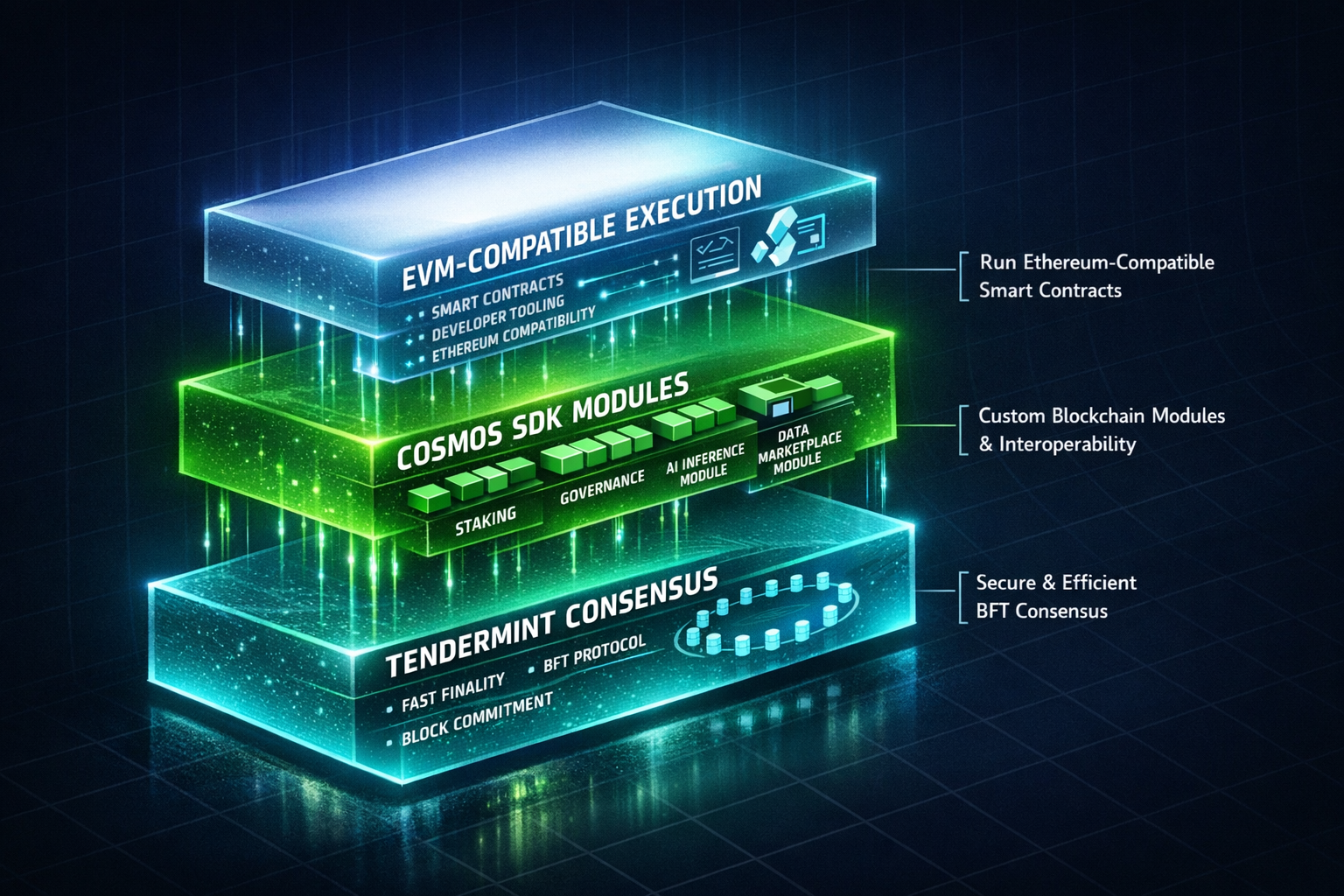
Architectural choices in blockchain are never arbitrary — or shouldn't be. Every component of AIVM's stack was selected to solve a specific AI infrastructure requirement. Here's the stack and the reasoning.
Tendermint consensus is a Byzantine Fault Tolerant (BFT) consensus engine. In plain terms: validators take turns proposing blocks, and a block is considered final once more than two-thirds of validators sign off on it. There's no waiting for additional confirmations, no probabilistic finality. A transaction is either final or it isn't — like a jury that must reach a supermajority verdict before the trial moves forward.
Why does this matter for AI? Because AI inference needs deterministic results. When you ask a model to classify a transaction as fraudulent or legitimate, you need that result to be final and verifiable immediately — not "probably correct pending six more block confirmations." Tendermint's instant finality gives AIVM the guarantee that once an AI computation is recorded, it's settled. Block times on Tendermint-based chains typically range from 1–6 seconds, which is fast enough for most inference-based workflows, though latency-critical applications (sub-100ms response requirements) will still need to evaluate whether on-chain settlement fits their performance envelope.
Cosmos SDK is a modular framework for building custom blockchains — think of it as LEGO bricks for chains. It provides pre-built modules for staking, governance, token transfers, and other standard blockchain functions. This lets ChainGPT's engineers focus their effort on the AI-specific modules (model execution, compute marketplaces, data validation) rather than reinventing basic plumbing. Cosmos chains also connect natively via IBC (Inter-Blockchain Communication), and AIVM plans additional cross-chain integration via Chainlink CCIP — connecting to Ethereum, Polygon, Solana, and other ecosystems.
EVM compatibility means any developer who has written Solidity can deploy on AIVM. MetaMask, Hardhat, Foundry, Ethers.js — all of it works. This is a strategic decision to tap into the largest smart contract developer ecosystem in crypto (estimated at 20,000+ monthly active developers). Same steering wheel, same dashboard — completely different engine underneath. AIVM also plans to ship dedicated SDKs for AI-specific operations: model deployment, inference requests, data marketplace interactions, and compute provisioning — all accessible through familiar developer tooling patterns.
Traditional EVM Chain
AIVM
✓General-purpose execution
✓AI-native dual-path execution
✓Probabilistic or slower finality
✓Instant Tendermint BFT finality
✓Single validator type
✓Four specialised validator types
✓No native AI modules
✓Built-in compute and data marketplaces
04
The Dual-Path Execution Model: AIVM's Core Innovation
AIVM illustration 4
AIVM visual 4
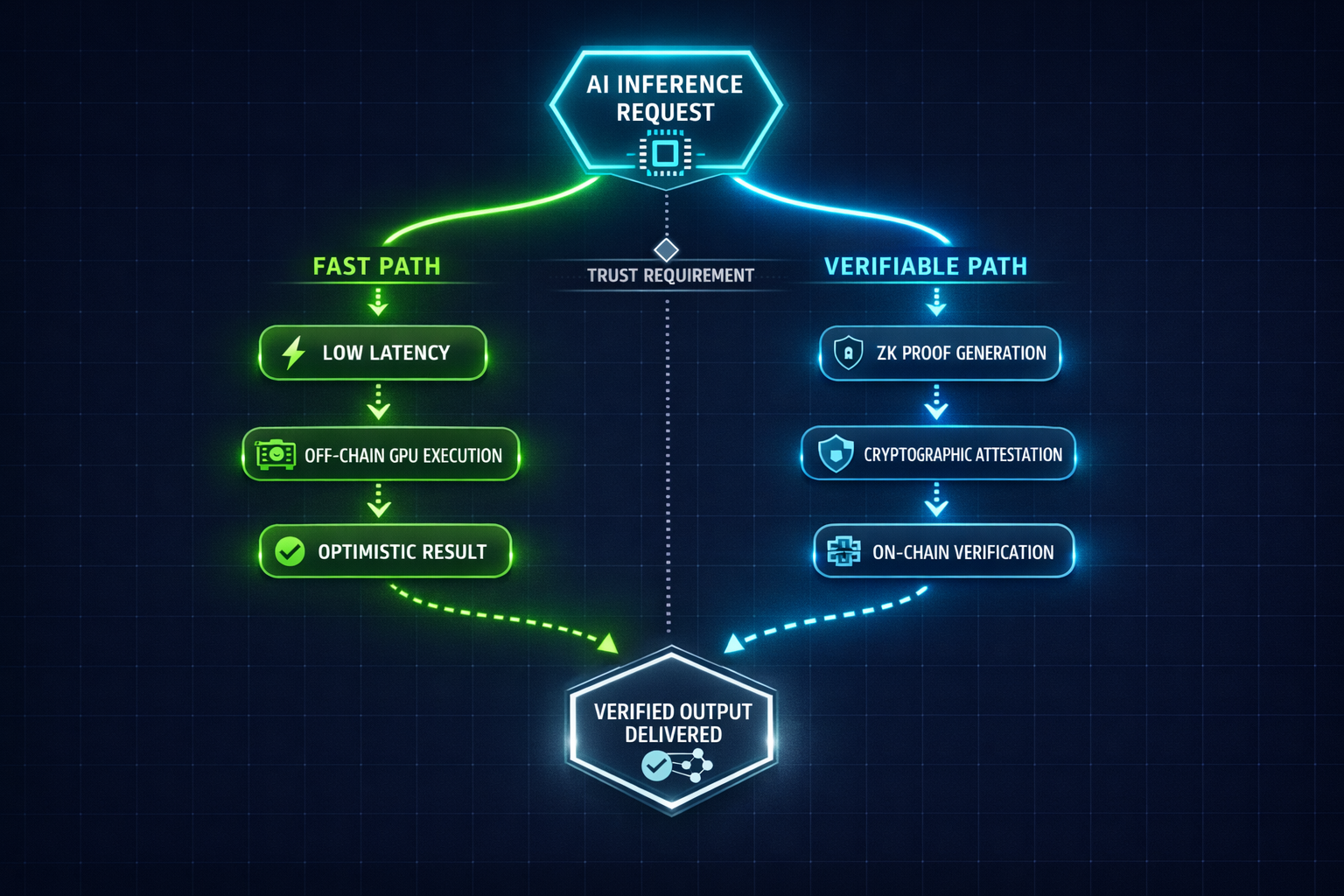
This is the architectural feature that most clearly separates AIVM from everything else in the market. It addresses a fundamental impossibility: you cannot run a large language model on every node in a blockchain network. The cost would be astronomical, the latency absurd. But you also can't just run AI off-chain and trust the operator — that reintroduces the centralisation problem.
AIVM's answer is a dual-path execution model that routes workloads based on complexity.
Path 1: Simple models execute on-chain. Lightweight classification models, fraud detectors, small neural networks — workloads that are computationally modest enough for blockchain nodes to handle. These run directly in AIVM's execution environment, and every validator can re-execute the computation to verify correctness. Maximum transparency. Maximum verifiability. Think models under a few hundred megabytes with inference times measured in milliseconds.
Path 2: Complex models execute off-chain with ZK proofs. Large language models, image generators, multi-billion-parameter networks — workloads too expensive for on-chain execution. These run on dedicated compute infrastructure off-chain. The operator then generates a zero-knowledge proof (ZK proof) that the computation was performed correctly: the right model was used, the right inputs were processed, and the output is genuine.
That ZK proof is submitted on-chain, where it can be verified cheaply and quickly by AIVM's AI Validators. The proof is mathematically unforgeable — you cannot generate a valid proof for a computation you didn't actually perform.
The chain handles routing automatically. Developers deploy their AI workloads, and the protocol determines the appropriate execution path. Small packages go through the lobby; oversized shipments use the loading dock. Both arrive verified.
Important performance caveat: ZK proof generation for large model inference is computationally expensive and adds latency overhead. Current state-of-the-art ZKML implementations can add seconds to minutes of proof generation time depending on model complexity. This means AIVM's off-chain path is well-suited for batch processing, asynchronous workflows, and applications where result integrity matters more than sub-second response times. Real-time conversational AI at scale remains a challenge for any ZK-verified approach — and AIVM's testnet performance data will be critical in evaluating practical throughput.
This dual-path approach is the pragmatic engineering solution to what is effectively a trilemma: you can have large AI models, on-chain execution, and reasonable cost — but not all three simultaneously. AIVM optimises by keeping small models fully on-chain and using cryptographic proofs to extend trust to off-chain computation.
1
Developer submits AI workload
Model and inputs are registered on AIVM
2
Protocol routes based on complexity
Simple models go on-chain; complex models go off-chain
3
Execution occurs
On-chain nodes run simple models directly; off-chain operators run complex models on GPUs
4
Verification
On-chain results are re-executable by all validators; off-chain results verified via ZK proofs
5
Result is finalised
Tendermint BFT consensus confirms the result is final and immutable
05
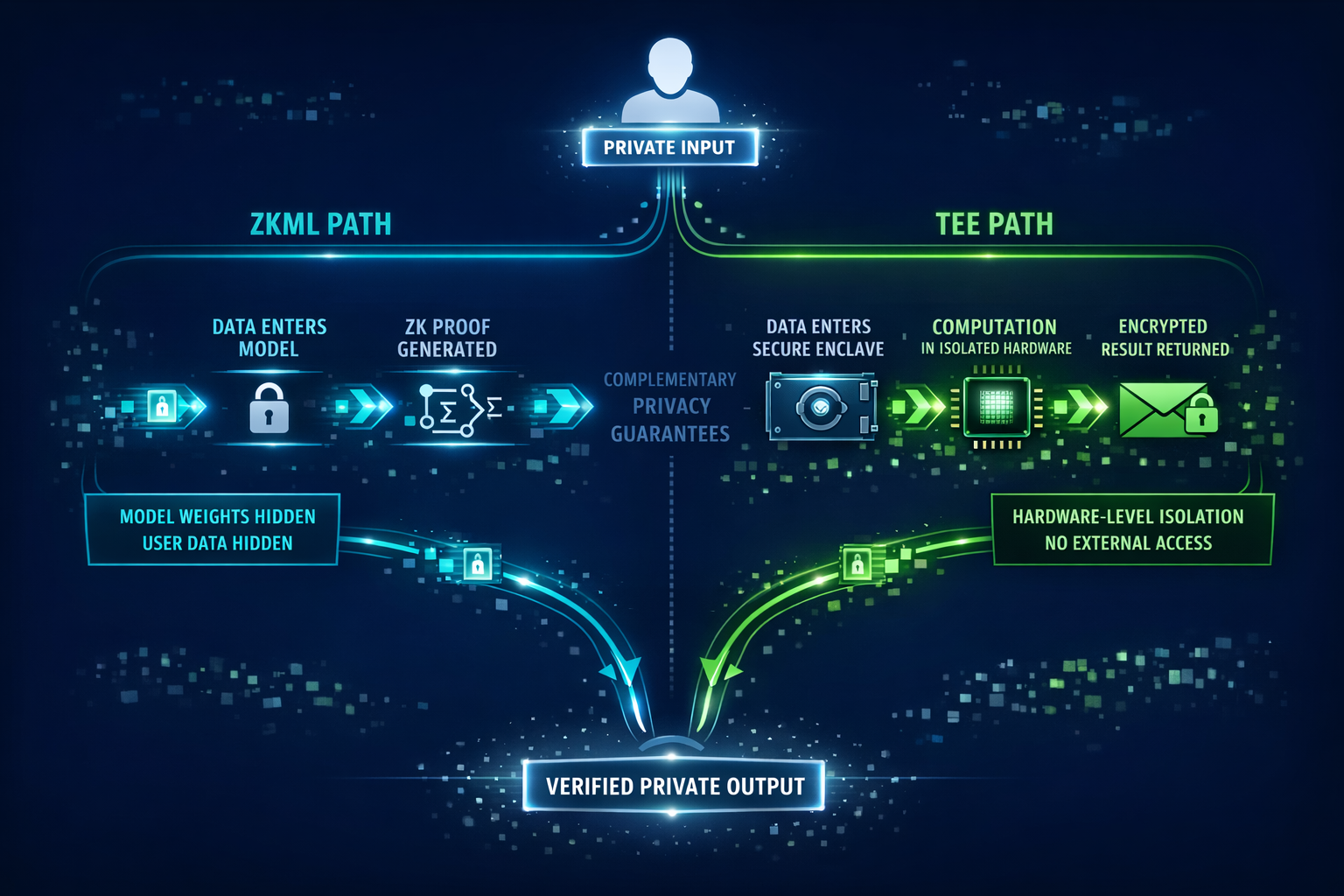
The Privacy Layer: ZKML and TEEs Working Together
AIVM illustration 5
AIVM visual 5
Here's a problem that gets less attention than it should: AI inherently involves sensitive data. Medical records. Financial transactions. Personal preferences. Proprietary business logic. If you put all of this on a public blockchain in plaintext, it's visible to everyone. That's a non-starter for virtually every real-world application.
AIVM addresses this with two complementary privacy technologies:
ZKML (Zero-Knowledge Machine Learning) applies zero-knowledge proofs specifically to machine learning inference. A model can process your data and produce a result without revealing either the data or the model weights to anyone. The proof confirms: "this output came from running this specific model on this specific input" — without exposing either. It's like proving you're over 21 without showing your ID. The bouncer knows you qualify but never sees your birthday.
TEEs (Trusted Execution Environments) are hardware-based secure enclaves — think Intel SGX or ARM TrustZone — where code and data are processed in isolation. Even the machine's operator can't see what's happening inside. A soundproof, windowless room: data goes in, results come out, nobody peeks during computation.
Why both? Because neither is perfect alone. TEEs have had documented side-channel attacks — SGX has been compromised by researchers multiple times (the Plundervolt and SGAxe attacks being notable examples). Relying solely on hardware is risky. ZKML provides an independent, mathematical guarantee that doesn't depend on hardware integrity. Together, they create defence in depth: even if one layer is compromised, the other still holds.
Regulatory relevance: This privacy architecture is particularly significant as jurisdictions worldwide implement stricter data protection requirements. The EU's AI Act, GDPR, and similar frameworks in Asia and North America create compliance challenges for any AI infrastructure handling personal data. AIVM's privacy-preserving design doesn't automatically guarantee regulatory compliance — that depends on implementation details and jurisdictional specifics — but it provides the technical primitives that compliance frameworks require. Decentralised AI infrastructure that can demonstrably protect data privacy has a structural advantage in regulated industries.
This isn't a theoretical concern. Without robust privacy, a decentralised AI platform is limited to processing public data — which dramatically narrows its usefulness. AIVM's privacy layer is what opens the door to the use cases that actually generate revenue: enterprise analytics, medical diagnostics, financial risk scoring, personalised recommendations. The stuff that matters.
→
Why Dual-Layer Privacy Matters
Most competing AI chains offer either ZK-based privacy OR TEE-based privacy — not both. AIVM's combination of ZKML (mathematical guarantee) and TEEs (hardware isolation) is the strongest privacy architecture in the decentralised AI space. This is what makes AIVM viable for healthcare~ finance~ and enterprise use cases — not just crypto-native applications.
06
Four Validator Types: A Specialised Division of Labour
AIVM illustration 6
AIVM visual 6
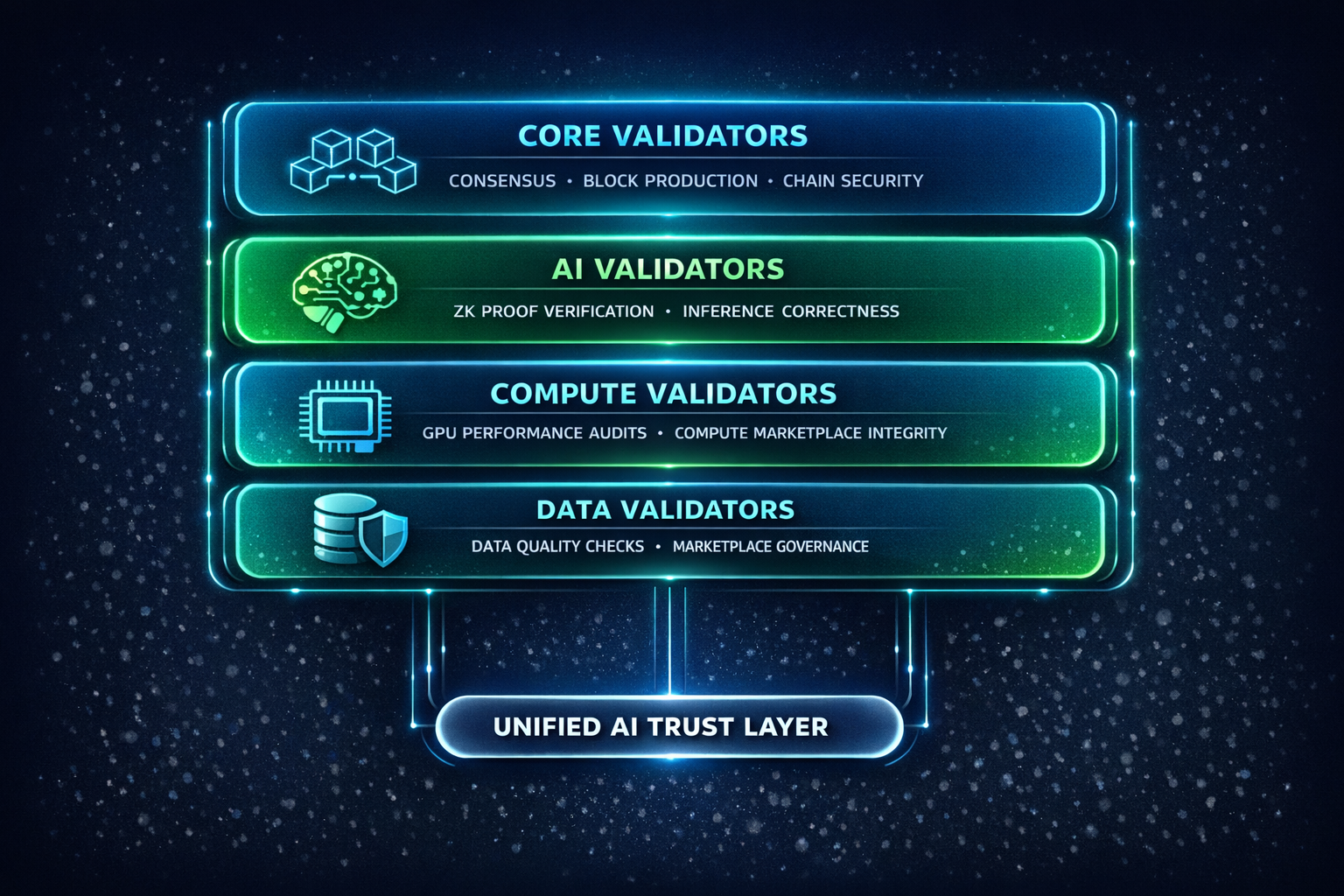
Traditional blockchains have one type of validator that does everything: propose blocks, validate transactions, maintain state. AIVM takes a fundamentally different approach, splitting validation into four specialised roles — each responsible for a different dimension of network integrity.
1. Core Validators secure the Tendermint consensus layer. They propose and sign blocks, maintain chain state, and ensure the network keeps running. This is the foundational role, analogous to validators on any proof-of-stake chain.
2. AI Validators are the referees for model execution. When an off-chain AI computation produces a result and a ZK proof, AI Validators verify that proof on-chain. They ensure inference correctness — confirming that the claimed model was actually run, the claimed inputs were actually used, and the output is genuine. Without them, off-chain computation would be unverifiable.
3. Compute Validators are the quality inspectors for GPU infrastructure. The compute marketplace will have many providers offering GPU resources — from enterprise data centres to individual operators. Compute Validators monitor performance, uptime, and SLA compliance. If a provider claims to offer 8x A100 GPUs but delivers intermittent, throttled performance, Compute Validators flag it and enforce accountability.
4. Data Validators are the librarians and auditors for the data marketplace. They verify data integrity (datasets haven't been tampered with), privacy compliance (sensitive data is properly anonymised or encrypted), and quality standards. In a marketplace where data is bought and sold for AI training, someone needs to ensure the goods are legitimate.
Why does specialisation matter? Because AI workloads are heterogeneous. Securing consensus, verifying ZK proofs, monitoring GPU performance, and auditing data quality are four fundamentally different tasks requiring different hardware, different expertise, and different economic incentives. A hospital has surgeons, radiologists, anesthesiologists, and nurses — not one person doing all four jobs.
Operators can choose to specialise in one or more roles based on their capabilities. End users never need to think about this; it's infrastructure-level engineering that ensures each aspect of the network is validated by specialists, not generalists. Specific hardware requirements and staking minimums for each validator type will be detailed as testnet onboarding progresses — early participants should monitor AIVM's official documentation for updated specifications.
07
The AI Economy: Data Marketplace, GPU Marketplace, and $CGPT
AIVM illustration 7
AIVM visual 7
Architecture is necessary but not sufficient. A blockchain without an economy is academic. AIVM's economic layer consists of two integrated marketplaces and one token that powers everything.
The AI Data Marketplace
A decentralised platform where data providers list datasets — curated, labelled, structured data for AI training and fine-tuning — and data consumers purchase access using $CGPT. Data Validators enforce quality and privacy standards. Pricing is set by market dynamics, not corporate gatekeepers.
This directly challenges the status quo where training data is either scraped without consent (legally questionable, ethically worse) or locked behind corporate APIs at corporate pricing. The AIVM data marketplace creates a legitimate, transparent market for AI training data with cryptographic provenance.
The GPU Compute Marketplace
An Airbnb-for-GPUs model. Anyone with spare GPU capacity — data centres, crypto miners with idle hardware post-Merge, individuals with high-end gaming rigs — can offer compute resources on AIVM. AI developers rent what they need. Compute Validators enforce performance SLAs.
The GPU Marketplace SDK is part of the Q1–Q2 2026 public testnet rollout, and this is where one of AIVM's most significant recent partnerships comes in: Alibaba Cloud integration, confirmed in January 2026, brings enterprise-grade Nvidia GPU infrastructure into the marketplace. Developers get access to top-tier hardware at competitive rates, without needing corporate cloud accounts or enterprise sales conversations.
By aggregating underutilised GPUs globally and eliminating cloud provider margins, decentralised compute can be materially cheaper for batch and asynchronous workloads. Not always. Not for every use case. Real-time inference with strict latency requirements (sub-100ms) may still favour co-located centralised infrastructure. But for a substantial portion of AI training and inference workloads — fine-tuning, batch inference, research experimentation — the economics work.
$CGPT: The Token That Powers Everything
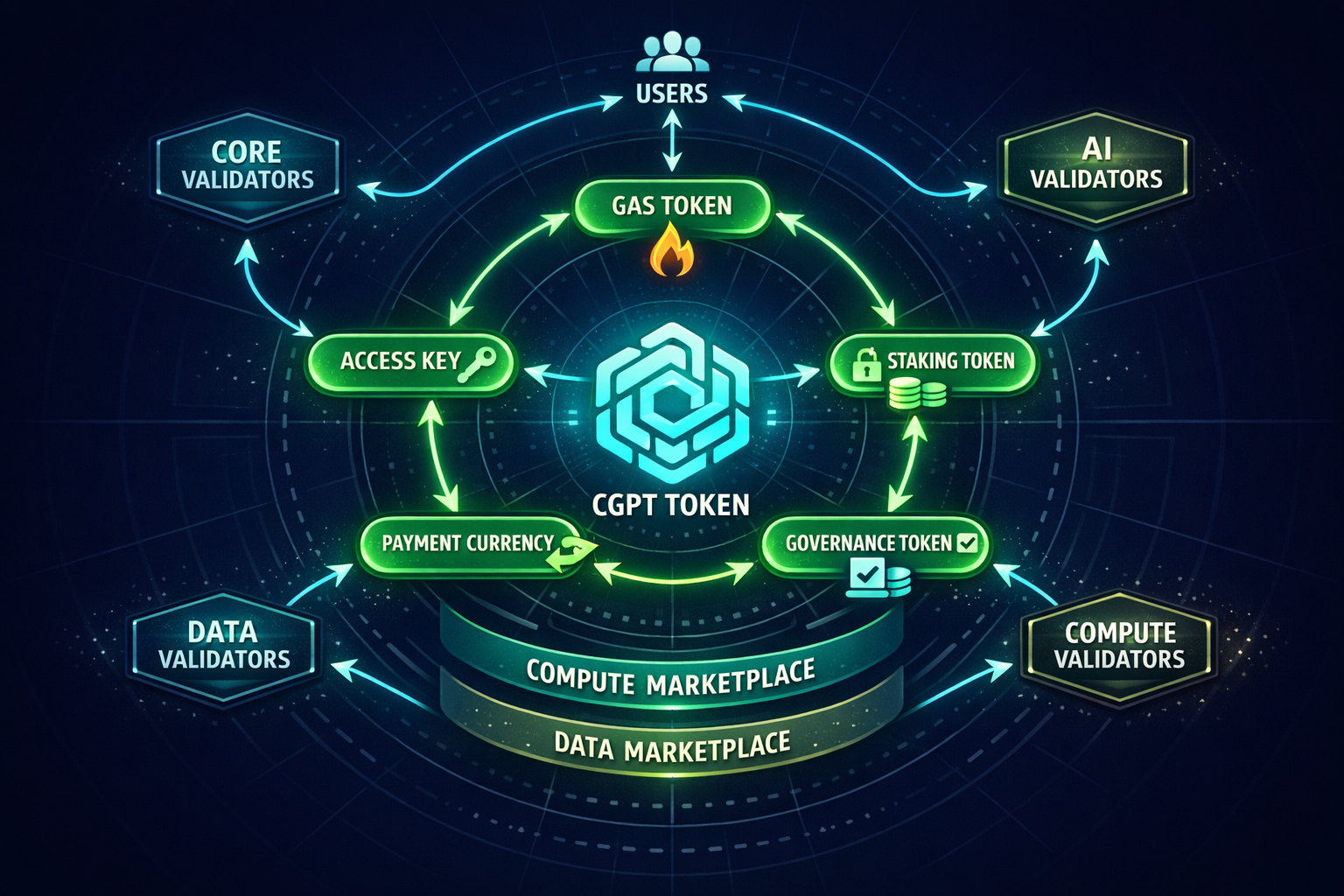
$CGPT is AIVM's native gas and utility token — and it's already live. Not a future token sale. Not a placeholder. A real token traded on Binance, KuCoin, ByBit, Gate.io, MEXC, PancakeSwap, and Uniswap with real liquidity today. To be clear on the relationship: $CGPT originated as ChainGPT's ecosystem token and is being extended to serve as the native token for the AIVM network. It's the same token, now with an expanded role as the gas and settlement currency for an entire Layer-1 blockchain.
On AIVM, $CGPT serves four roles:
›Gas token: Pay transaction fees on the network
›Staking token: Validators stake $CGPT to participate in consensus and earn rewards
›Payment token: Settle transactions in the data marketplace and compute marketplace
›Governance token: Vote on protocol upgrades and parameter changes
For readers who want to verify the token contracts independently:
Here's what makes $CGPT unusual in the AI crypto landscape: it already has demand drivers. The existing ChainGPT ecosystem — chatbot, smart contract tools, NFT generator, trading assistant, launchpad, CryptoGuard, and AgenticOS — all use $CGPT today. AIVM doesn't need to create demand from zero; it amplifies demand that already exists by making $CGPT the settlement currency for an entire AI economy.
The economic flywheel is straightforward: data providers earn $CGPT, compute providers earn $CGPT, validators earn $CGPT, and AI consumers spend $CGPT. Every marketplace transaction generates gas fees. Every validator needs a stake. The more activity on AIVM, the more organic demand for the token.
The protocol has been audited by both CertiK and Hacken — two of the most recognised security audit firms in the space. That's not a guarantee of perfection, but it's the minimum viable trust signal for a project of this scale.
08
How AIVM Compares: An Honest Competitive Analysis
AIVM illustration 8
AIVM visual 8
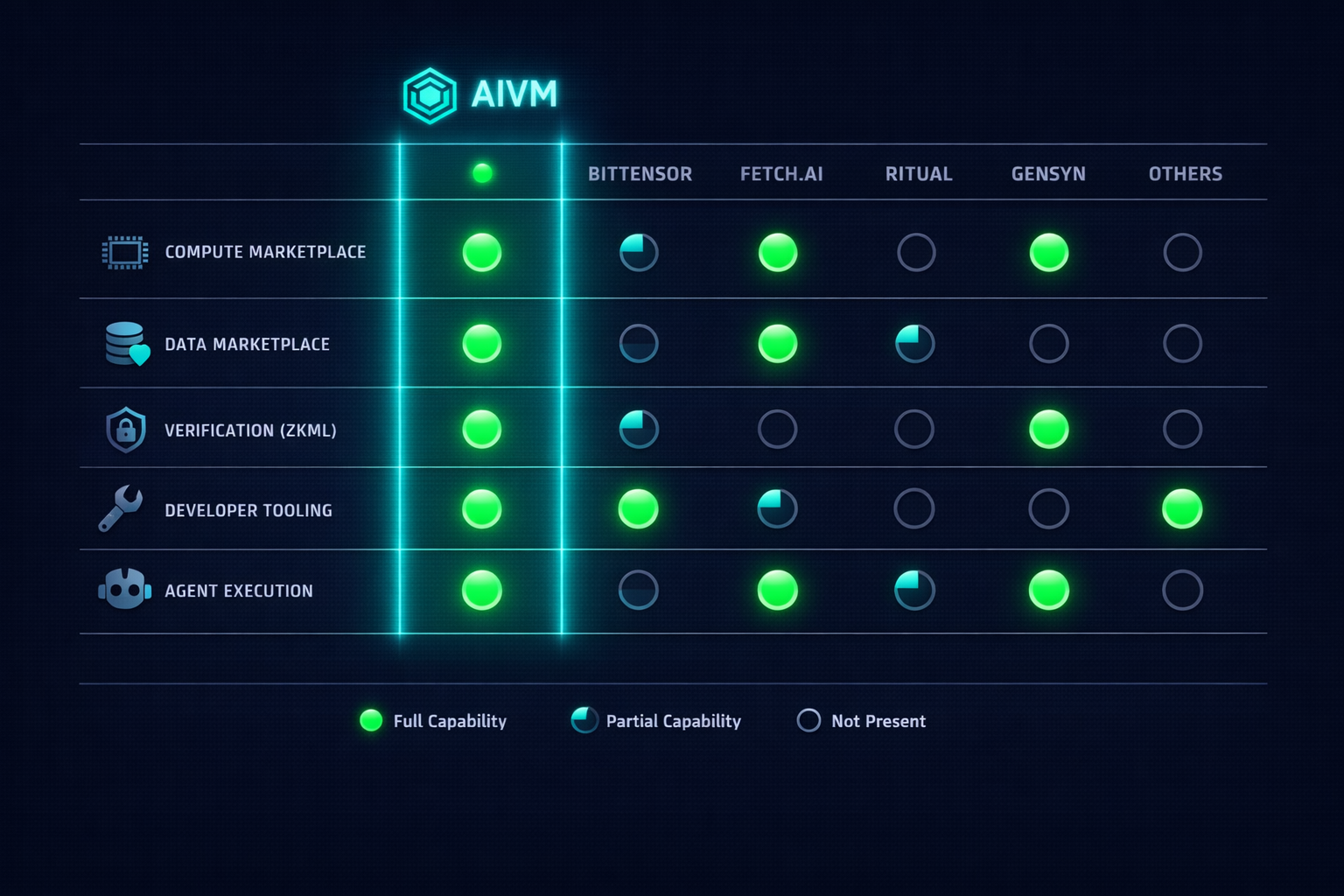
I'm not going to pretend AIVM has no competition. The decentralised AI space is real, it's growing, and several projects have meaningful traction. Here's where things actually stand:
Bittensor ($TAO, ~$2.8B mcap) has a live mainnet with active ML subnets where miners compete to produce the best model outputs. It's arguably the most mature decentralised model training network with proven economic dynamics and real validator participation. But it doesn't have an integrated data marketplace, isn't EVM-compatible, and lacks a ZK privacy layer. It's a powerful incentivisation engine for model training — but not a full-stack AI infrastructure chain.
Ritual is building an AI coprocessor that brings verifiable inference to existing chains through cryptographic attestation. It's the closest competitor in terms of ZK-verified AI computation. The key difference: Ritual is designed as middleware that plugs into existing blockchains, while AIVM is a sovereign Layer-1 with integrated marketplaces. Both approaches have merit — Ritual benefits from existing chain security, AIVM benefits from architectural control.
Gensyn focuses specifically on verifiable distributed training — breaking large model training jobs across decentralised compute and using probabilistic verification to ensure correctness. Strong technical team and well-funded. Where AIVM targets the full stack (compute + data + inference + privacy), Gensyn goes deep on the training verification problem.
Akash Network and io.net both operate decentralised compute marketplaces. Akash is a general-purpose cloud alternative on Cosmos with a live mainnet and real workloads. io.net specifically aggregates GPU clusters for AI. Both have demonstrated that decentralised compute can achieve competitive pricing. They're strong competitors to AIVM's GPU marketplace component, but neither offers integrated data marketplaces, AI-specific execution verification, or ZKML privacy.
Fetch.ai ($FET, ~$1.8B mcap) pioneered autonomous AI agents and has been live since 2019. Strong agent framework, serious team. Now merged into the ASI Alliance with Ocean Protocol and SingularityNET. The merger creates breadth on paper but also introduces integration complexity — three codebases, three communities, three governance structures.
Ocean Protocol ($OCEAN, ~$350M mcap) is the closest competitor to AIVM's data marketplace. It's proven the concept works and has real marketplace participants. But Ocean is data-only — it doesn't offer compute or model execution. On AIVM, the data marketplace lives on the same chain that runs the models that consume the data. No bridging, no context-switching.
SingularityNET ($AGIX, ~$1.2B mcap) built an AI services marketplace — list algorithms, pay for inference. Live since 2018. But it's more of an application layer than an infrastructure layer.
AIVM's core thesis is that the market doesn't want five separate protocols duct-taped together. It wants one chain where compute, data, execution, privacy, and developer tooling are natively integrated. Whether that thesis is correct — and whether ChainGPT can execute on it — remains to be proven. But the architectural approach is clearly differentiated.
I'll also note what competitors have that AIVM doesn't — yet. Bittensor has a live mainnet with proven economic dynamics. Ritual has functioning verifiable inference in production. Akash has real workloads running on decentralised compute. Fetch.ai has years of agent deployment data. Ocean has an established data marketplace with real participants. AIVM's public testnet is live now; mainnet is targeted for Q2–Q3 2026. In infrastructure, being later isn't automatically a disadvantage — you learn from predecessors' limitations — but it does mean execution timelines matter enormously.
Competitors (Bittensor
Ocean
✓Fetch.ai
✓AGIX)
09
Where AIVM Stands Today: The Roadmap
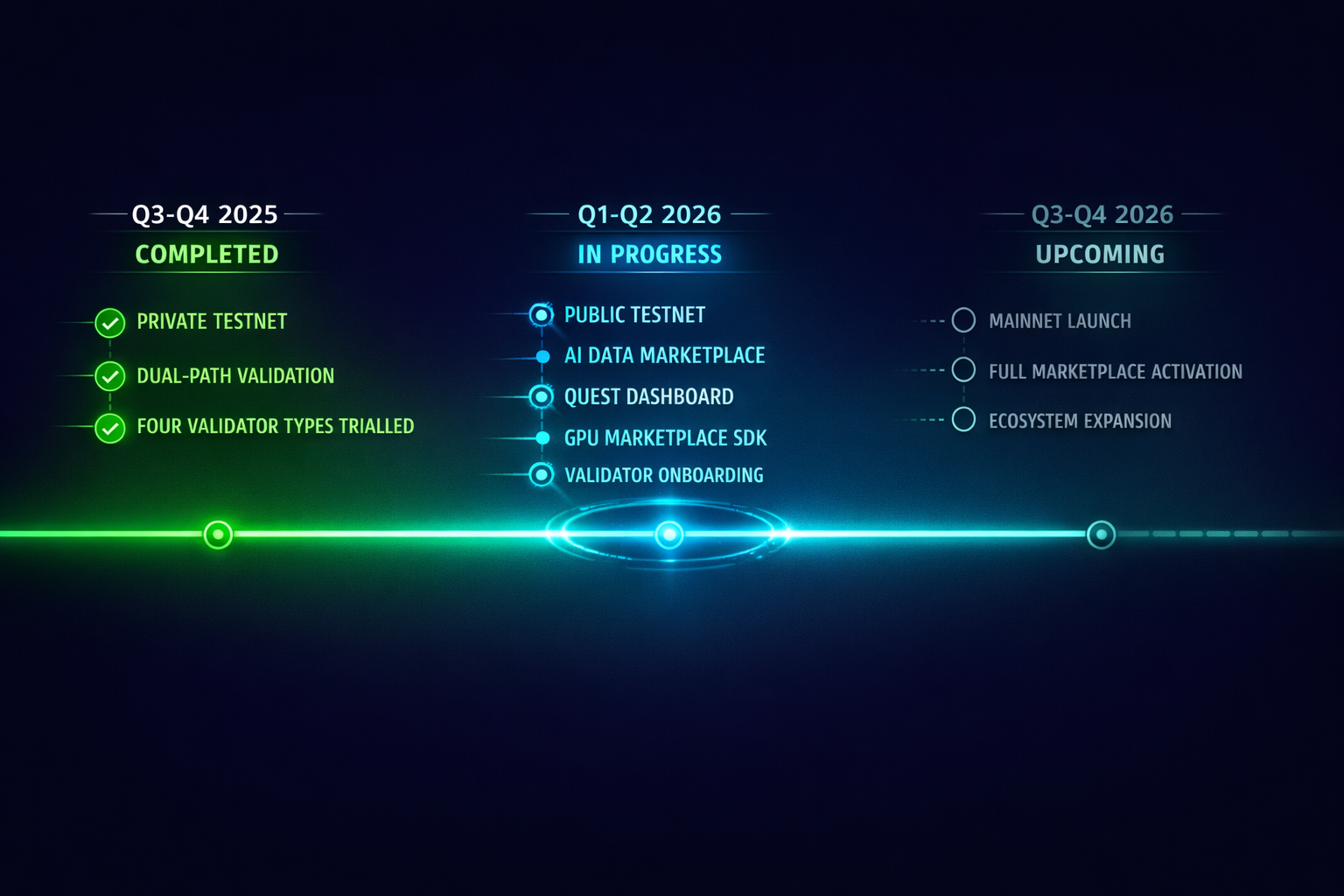
Let's be precise about what's done, what's happening now, and what's ahead.
Completed (Q3–Q4 2025): Private testnet. Core protocol, consensus mechanism, basic AI inference verification — all tested in a controlled environment.
In Progress NOW (Q1–Q2 2026): Public testnet. This is the current phase, and it includes:
›AIVM website release
›Web app launch: AI Data Marketplace, Quest Dashboard, Block Explorer
›GPU Marketplace SDK
›Validator onboarding — the first external operators joining the network
Planned (Q2–Q3 2026): Mainnet launch, including:
›Full AI Compute Resource Marketplace
›Cross-chain integration via Chainlink CCIP
›Oracle integration for external data feeds
The partnerships underpinning this timeline are substantial: Google Cloud for infrastructure, Nvidia for GPU support, Alibaba Cloud for GPU marketplace integration, Binance/BNB Chain, Polygon, Solana, Ethereum, Cronos, Hedera, Chainlink, Magic Eden, and Blockdaemon for various infrastructure and ecosystem roles.
Honest caveats, because they matter: Mainnet timelines in crypto are more aspirational than contractual. Blockchain launches frequently slip — and for infrastructure this complex, a delay for security and stability is preferable to a premature launch. The Q2–Q3 2026 target is the current plan, not a guarantee. Judge the project by its testnet performance, not its slide deck.
10
How to Get Involved
The public testnet is the inflection point — the moment AIVM goes from "internal development" to "community-verifiable reality." If you've read this far and want to explore it firsthand, here's what you can do:
Explore the testnet. The web app includes a block explorer, AI Data Marketplace, and Quest Dashboard. You can see the chain running, inspect blocks, and participate in structured activities.
Consider running a validator. If you have the technical chops and the hardware, validator onboarding is active during the testnet phase. Four specialised roles mean there's flexibility depending on your infrastructure.
Participate in quests. The Quest Dashboard offers structured activities for testnet participants. These are designed to stress-test the network while giving the community hands-on experience.
Hold or stake $CGPT if you want economic exposure to the ecosystem. It's available on all the major exchanges and DEXs listed above.
One important note: no official airdrop has been announced. If you're participating in the testnet expecting guaranteed token rewards, recalibrate your expectations. Testnet participation may yield benefits — many projects have rewarded early participants — but nothing has been confirmed. Participate because you find the technology interesting and want to contribute, not because you're banking on a specific outcome.
Getting Started with AIVM
✓
Create a ChainGPT account via the web app
✓
Explore the AIVM block explorer and data marketplace
✓
Check the Quest Dashboard for testnet activities
✓
Follow the Telegram (544K subscribers) and Discord for testnet updates
✓
Consider validator onboarding if technically inclined
11
The Bigger Picture
Zoom out for a moment.
In 2020, we recognised that traditional finance needed a decentralised alternative, and DeFi was born. In 2021, we recognised that data storage needed a decentralised alternative, and Filecoin and Arweave gained traction. In 2024–2025, we recognised that AI — the most transformative technology of this decade — was becoming the most centralised technology of this decade.
AIVM is ChainGPT's answer: purpose-built infrastructure for decentralised AI. Not a narrative play. Not a general-purpose chain with a marketing rebrand. A dedicated Layer-1 with dual-path execution, ZKML and TEE privacy, four specialised validator types, integrated compute and data marketplaces, and EVM compatibility for developer adoption — all powered by a token that's already live and an ecosystem that's already shipping products.
Will it work? That depends on execution — on whether the testnet performs under real load, whether validators join in sufficient numbers, whether the compute marketplace achieves competitive pricing, whether developers build on it, and whether AIVM can deliver practical latency and throughput that competes with centralised alternatives for real workloads. The architecture is sound. The partnerships are institutional-grade. The existing product traction is real. But infrastructure is proven in production, not in articles.
The public testnet is where the community gets to verify the claims for themselves. That process is underway now.
---
This article is educational content and does not constitute financial advice. All investment decisions carry risk. Cryptocurrency and blockchain technologies are inherently volatile and unpredictable. Always conduct your own research (DYOR) before making any financial commitments. Mainnet timelines, features, and ecosystem developments discussed in this article are subject to change. Market capitalisation figures cited are approximate and were current at the time of writing.