AIVM Tokenomics Deep Dive: How $CGPT Powers the AI Virtual Machine Economy
An in-depth analysis of AIVM's tokenomics architecture, exploring how ChainGPT's existing $CGPT token is being elevated to serve as the native gas token for a purpose-built AI Virtual Machine Layer-1 blockchain. The article examines the demand dynamics, supply migration complexities, multi-chain liquidity considerations, and novel staking economics that arise from this structurally unusual approach.
→AIVM is a Layer-1 blockchain built on Tendermint consensus and Cosmos SDK, designed specifically for decentralised AI computation with EVM compatibility and dual-path execution using zero-knowledge proofs.
→The core tokenomics innovation is using $CGPT — an already-existing, actively traded token with over 700,000 users — as the native gas token for the new L1 chain rather than launching a fresh token.
→Elevating an existing utility token to a native L1 gas token fundamentally changes demand dynamics in ways that surface-level analysis often misses.
→The architecture introduces complexities around supply migration, multi-chain liquidity fragmentation, and staking economics across four specialised validator types unique to the AI blockchain landscape.
700K+
Community Members
5
Major CEX Listings
2
Security Audits
01
What Happens When a Live Token Becomes the Gasoline for an Entire AI Economy?
Most Layer-1 blockchains launch with a fresh token, a blank community, and a prayer. AIVM is doing something structurally different — and whether you're bullish, bearish, or undecided on the crypto-AI thesis, the tokenomics architecture here deserves serious examination.
AIVM, ChainGPT's purpose-built AI Virtual Machine, is a Layer-1 blockchain designed from the ground up for decentralised AI computation. It's built on Tendermint consensus with the Cosmos SDK, it's EVM-compatible, and it features a dual-path execution model that routes simple AI models on-chain while handling complex inference off-chain with zero-knowledge proofs. That's architecturally interesting. But the tokenomics decision that makes it genuinely unusual is this: the gas token powering the entire chain is $CGPT — a token that already exists, already trades on Binance, KuCoin, ByBit, Gate.io, MEXC, PancakeSwap, and Uniswap, and already services an ecosystem of over 700,000 users.
That single decision — elevating an existing utility token to a native L1 gas token — changes the demand dynamics for $CGPT in ways that most surface-level analysis misses entirely. It also introduces complexities around supply migration, multi-chain liquidity fragmentation, and staking economics across four specialised validator types that don't exist anywhere else in the AI blockchain landscape.
This article is a framework for thinking about those dynamics clearly. Not hype. Not financial advice. A toolkit.
The public testnet is live now, as of Q1-Q2 2026. Mainnet is targeted for Q2-Q3 2026. The next six months will provide the data points that separate the thesis from reality. Let's map out what to watch and why it matters.
---
02
$CGPT Today: The Starting Position
Before we project forward, we need to ground ourselves in what $CGPT is right now.
$CGPT is the native token of the ChainGPT ecosystem, a suite of AI-powered tools built for the Web3 space. It currently exists as a BEP-20 token on BNB Chain (contract: 0x9840652DC04fb9db2C43853633f0F62BE6f00f98) and an ERC-20 token on Ethereum (contract: 0x25931894a86d47441213199621f1f2994e1c39aa). It's listed on five major centralised exchanges and two leading decentralised exchanges. That is non-trivial infrastructure for any token, let alone one in the crypto-AI vertical.
The existing ChainGPT ecosystem includes products that are live and generating real usage:
›Web3 AI Chatbot — conversational AI for blockchain queries
›Smart Contract Generator and Auditor — AI-assisted Solidity development
›AI NFT Generator — generative AI for NFT creation
›ChainGPT Pad — an IDO launchpad at pad.chaingpt.org
›CryptoGuard — a security browser extension at cryptoguard.ai
›ChainGPT Labs — an incubation arm at labs.chaingpt.org
›Solidity LLM — an open-sourced large language model for smart contract development
›AgenticOS — a framework for building autonomous AI agents
All of these tools use $CGPT in some capacity. The community spans roughly 700,000+ members across Discord (31K–46K members), Telegram Chat (~150K), and Telegram News (~544K subscribers). The project has been audited by both CertiK and Hacken — dual security audits that matter when we're talking about a token that's about to underpin an entire Layer-1.
This is the foundation. Not vapourware. Not a whitepaper project. An existing token with existing liquidity, existing users, and existing products — about to undergo the most significant structural upgrade in its history.
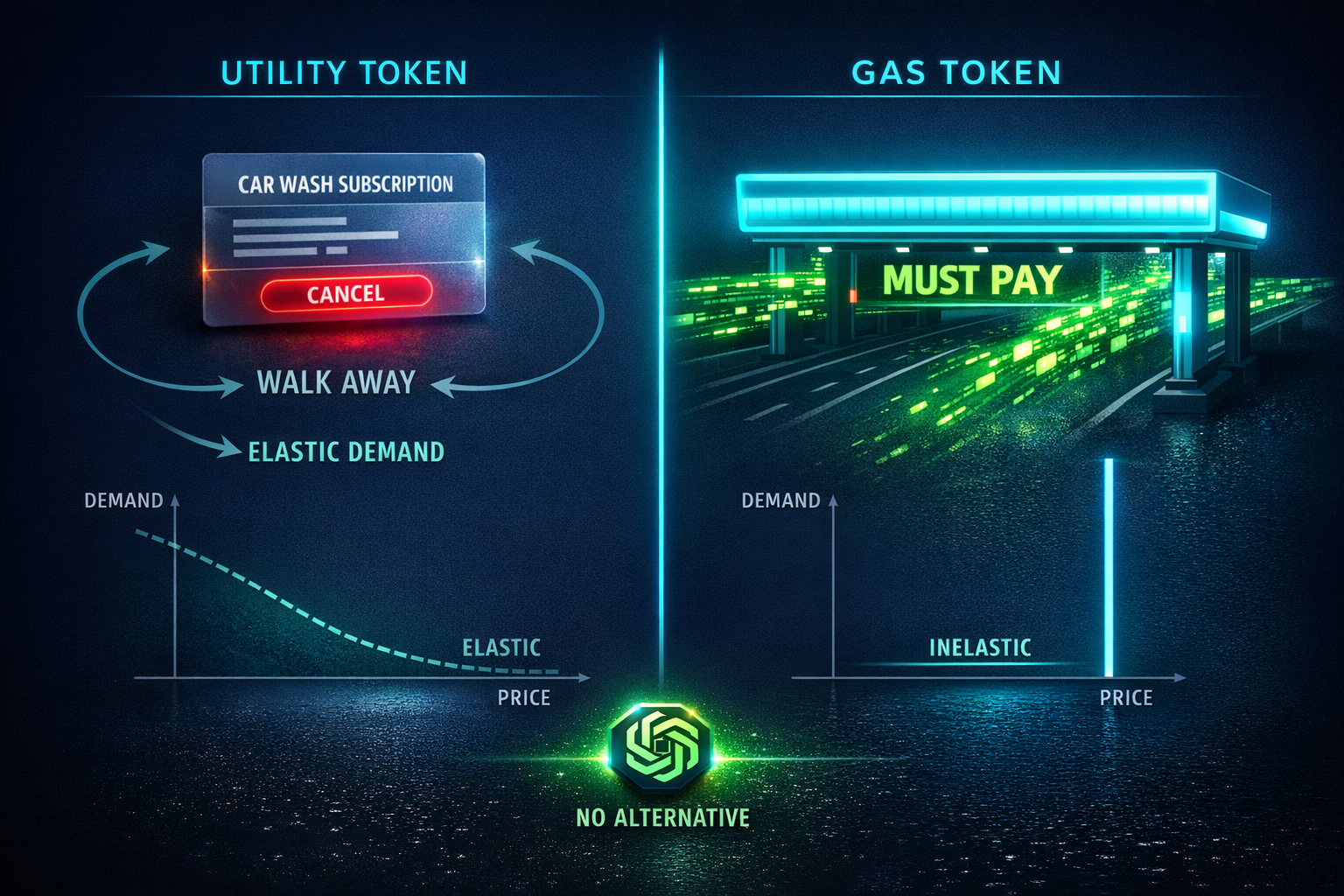
Side-by-side comparison showing elastic utility-token demand versus inelastic gas-token demand, visu
Here's the concept most people gloss over, and it's arguably the most important idea in this entire analysis.
There is a fundamental economic difference between a utility token and a gas token. A utility token has elastic demand — you choose to use it. If the ChainGPT chatbot charges $CGPT for premium features, you can decide the features aren't worth the price and walk away. Demand is optional.
A gas token has inelastic demand. If you want to do anything on AIVM — deploy a contract, run an AI inference, buy data, submit a transaction — you must hold and spend $CGPT. There is no alternative. There is no walking away. If AIVM has users, those users must acquire $CGPT. Period.
Think of it like this: a utility token is a car wash subscription. Nice to have, easy to cancel. A gas token is gasoline. If you want to drive, you're buying it.
When $CGPT migrates from a BEP-20/ERC-20 utility token to the native gas token of AIVM, it acquires this mandatory demand floor. The total supply isn't changing. The token isn't being reissued. But the structural demand profile is being fundamentally upgraded. This is one of the most powerful tokenomics transitions a project can execute, and it's underappreciated because it's subtle — no flashy launch event, no new ticker symbol, just a quiet shift in the demand curve's elasticity.
Most L1 projects launch a fresh gas token and face the cold-start problem: no holders, no liquidity, no exchange listings, no community. AIVM sidesteps this entirely. $CGPT already has deep liquidity on Binance, a six-figure community, and multi-exchange infrastructure. But this approach also inherits complexity: existing holders have existing expectations, existing sell pressure exists at various price levels, and liquidity will fragment across BNB Chain, Ethereum, and AIVM during the migration period.
That trade-off — warm start versus inherited complexity — is a thread we'll pull on throughout this analysis.
---
Utility Token (Before)
Optional for ecosystem participation
✓Elastic demand — users choose to buy
✓Competes with alternatives
04
AIVM's Architecture Through a Tokenomics Lens
I'm not going to repeat the full technical architecture here — you can read the docs for that. What matters for tokenomics is how the architecture generates demand for $CGPT. Three architectural choices are particularly consequential.
AIVM routes AI workloads along two paths. Simple models — classification tasks, lightweight inference, basic predictions — execute directly on-chain. They consume gas like any standard smart contract call. $CGPT cost: relatively low per transaction, driven by computational complexity.
Complex models — large language models, image generators, sophisticated multi-step inference — execute off-chain within Trusted Execution Environments (TEEs). Think of TEEs as secure enclaves within hardware: locked rooms inside a computer where data can be processed without even the machine's owner seeing the contents. Nvidia's GPUs increasingly support this capability, which is directly relevant given AIVM's Nvidia partnership.
These off-chain executions produce ZKML proofs — zero-knowledge proofs applied to machine learning. In plain terms: you can prove that an AI model produced a specific output from a specific input without revealing the model weights or the input data. The proof is submitted on-chain and verified by specialised AI Validators.
The tokenomics implication is critical: more complex AI models cost more $CGPT. The off-chain compute provider charges for GPU time (paid in $CGPT through the compute marketplace). The AI Validator charges for proof verification (paid in $CGPT). Standard gas is consumed for the on-chain proof submission (paid in $CGPT). Three separate $CGPT sinks for a single complex inference.
This creates a natural scaling mechanism. As AI models grow more sophisticated — a secular trend that shows no signs of slowing — the per-inference $CGPT demand increases. On a standard L1, fees are driven by network congestion. On AIVM, fees are driven by computational complexity. That's a structurally different fee dynamic and one that aligns token demand with the broader trajectory of AI development.
EVM Compatibility Lowers Barriers to Developer Adoption
AIVM speaks Solidity. Existing Ethereum developers, existing tooling (Hardhat, Foundry, Remix), and existing smart contracts can port to AIVM with minimal friction. This matters for tokenomics because every additional application deployed on AIVM is another source of transaction volume, and every transaction requires $CGPT gas. The easier it is to build on AIVM, the faster the application ecosystem grows, and the faster $CGPT demand compounds.
Cosmos SDK Enables Native Governance
Cosmos SDK chains ship with built-in governance modules where token holders submit and vote on proposals that automatically execute if passed. This isn't advisory governance — it's binding. For an AI chain, the governance decisions are uniquely consequential: which AI models are permitted, what privacy standards are enforced, how compute provider SLAs are defined, how validator rewards are distributed. We'll return to governance later, but the architectural point is that $CGPT's governance utility is baked into the chain's foundation, not bolted on as an afterthought.
---
05
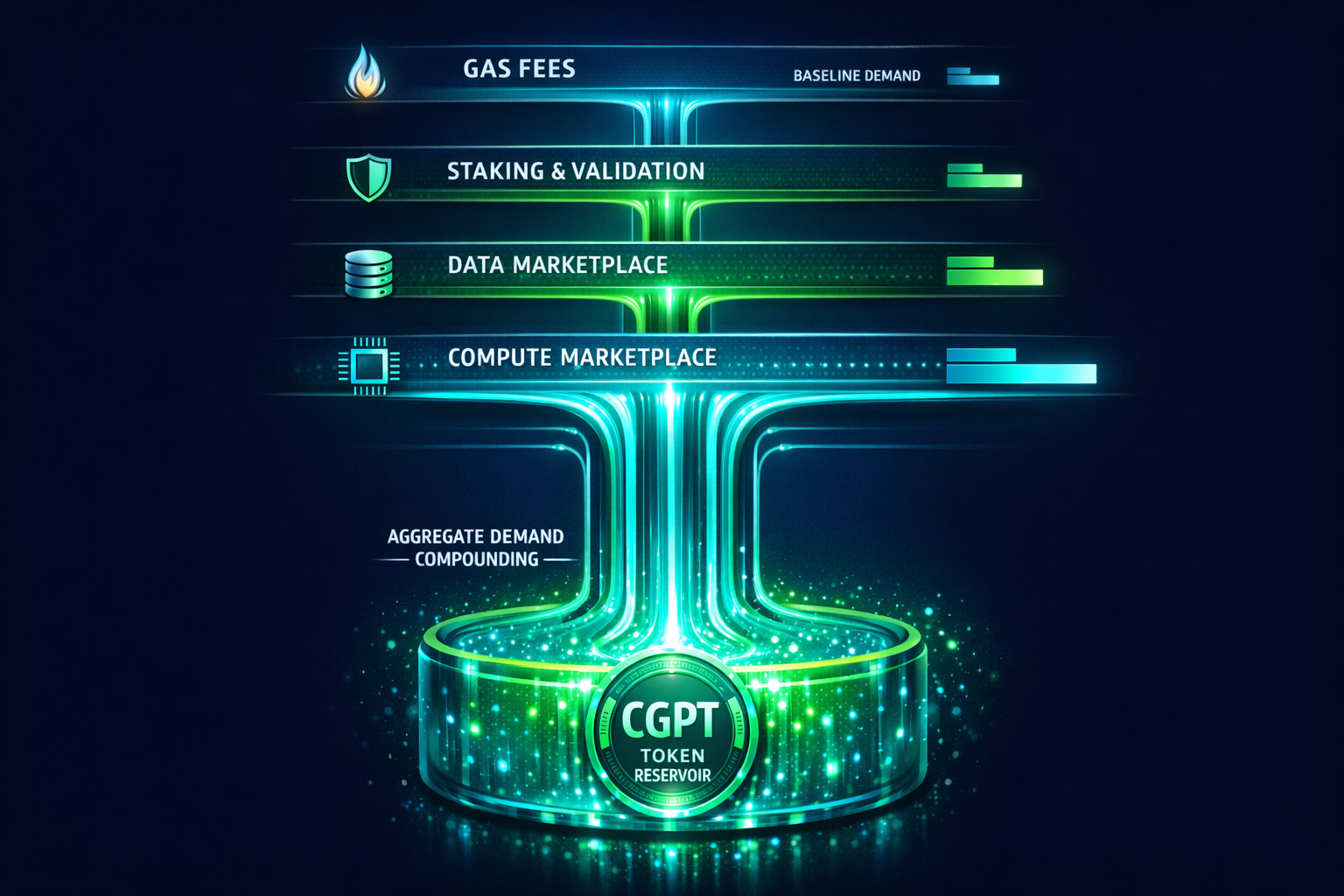
The Five Demand Drivers: Mapping Every $CGPT Sink
Anatomical diagram of five distinct CGPT demand sinks arranged by relative magnitude, showing how th
Anatomical diagram of five distinct CGPT demand sinks arranged by relative magnitude, showing how th
This is the analytical core. AIVM creates at least five distinct and persistent demand drivers for $CGPT. Let's map each one.
Driver 1: Gas Fees
The baseline. Every transaction on AIVM consumes $CGPT as gas. With Tendermint BFT consensus delivering fast finality (seconds, not minutes), throughput is high, and individual transaction costs should be low. But aggregate gas demand scales with total network activity. If AIVM processes millions of transactions daily — between AI inferences, marketplace trades, contract deployments, and agent interactions — the cumulative gas demand becomes material.
Honest assessment: gas fees alone are unlikely to be the dominant demand driver. Efficient L1s keep per-transaction costs minimal by design. The real demand drivers are below.
Driver 2: AI Compute Payments
This is potentially the largest $CGPT sink. The AI Compute Resource Marketplace, planned for mainnet launch in Q2-Q3 2026, allows users to rent GPU resources from providers and pay in $CGPT. Providers earn $CGPT for supplying compute.
The partnerships here are the key signal. Alibaba Cloud's GPU marketplace integration, confirmed in January 2026, means that a hyperscaler's GPU fleet could be accessible through AIVM's marketplace. Nvidia provides GPU infrastructure. Google Cloud provides backbone infrastructure. If even a fraction of enterprise AI compute demand routes through AIVM, the $CGPT volumes could be substantial — a single large enterprise training run or inference pipeline could generate more $CGPT demand than thousands of retail users.
Timeline caveat: the compute marketplace is roadmapped for mainnet. It does not exist yet. The GPU Marketplace SDK is part of the current public testnet phase.
Driver 3: Data Marketplace Transactions
The AI Data Marketplace is actively launching as part of the public testnet (Q1-Q2 2026). This marketplace enables buying and selling of training datasets, fine-tuning data, and model weights, all denominated in $CGPT. Data Validators maintain integrity and privacy compliance.
In the AI economy, data is the raw material. Quality training data commands premium prices. If AIVM becomes a trusted venue for AI data trading — especially privacy-preserving data trading via ZKML — this marketplace could generate significant and recurring transaction volume.
Driver 4: Model Access Fees
Developers who deploy AI models on AIVM can charge $CGPT for inference access, effectively creating a decentralised API marketplace. This extends the existing ChainGPT tooling model — the chatbot, smart contract auditor, NFT generator, and trading assistant already use $CGPT — to any developer building on AIVM.
The AgenticOS framework is particularly relevant here. As AI agents proliferate in crypto (autonomous trading, portfolio management, on-chain analysis), each agent interaction that routes through AIVM generates $CGPT demand. AgenticOS provides the developer framework; AIVM provides the execution environment; $CGPT captures the value.
All four validator types on AIVM require $CGPT staking. This is not one staking sink — it's four, each with different capital requirements, hardware demands, and reward profiles. We'll cover this in depth in the next section, but the aggregate effect is substantial: four specialised validator types means four pools of locked $CGPT, reducing circulating supply and creating persistent demand from operators who need to acquire and lock tokens to participate.
A Critical Misconception
Most of these demand drivers — the compute marketplace, the data marketplace at full scale, the cross-chain integrations — are roadmapped for mainnet. They don't exist at production scale today. Current $CGPT demand stems from the existing ChainGPT ecosystem tools, staking on existing chains, and speculative positioning for AIVM. The five demand drivers represent the target state, not the current state. Confusing the two is the fastest way to misanalyse this token.
---
1
1. Gas Fees
Every on-chain action (contract calls~ transfers~ proof submissions) requires $CGPT. High throughput via Tendermint means low per-tx cost but high aggregate demand.
2
2. AI Compute Payments
Users renting GPU resources via the Compute Marketplace pay providers in $CGPT. Alibaba Cloud and Nvidia partnerships supply the hardware.
3
3. Data Marketplace Transactions
Buying and selling training data~ fine-tuning datasets~ and model weights — all priced in $CGPT. Data Validators ensure integrity.
4
4. Model Access Fees
Developers gate access to deployed AI models behind $CGPT payments — a decentralised API economy for inference.
5
5. Validator Staking
All four validator types (Core~ AI~ Compute~ Data) require $CGPT staking. Four distinct lockup sinks.
06
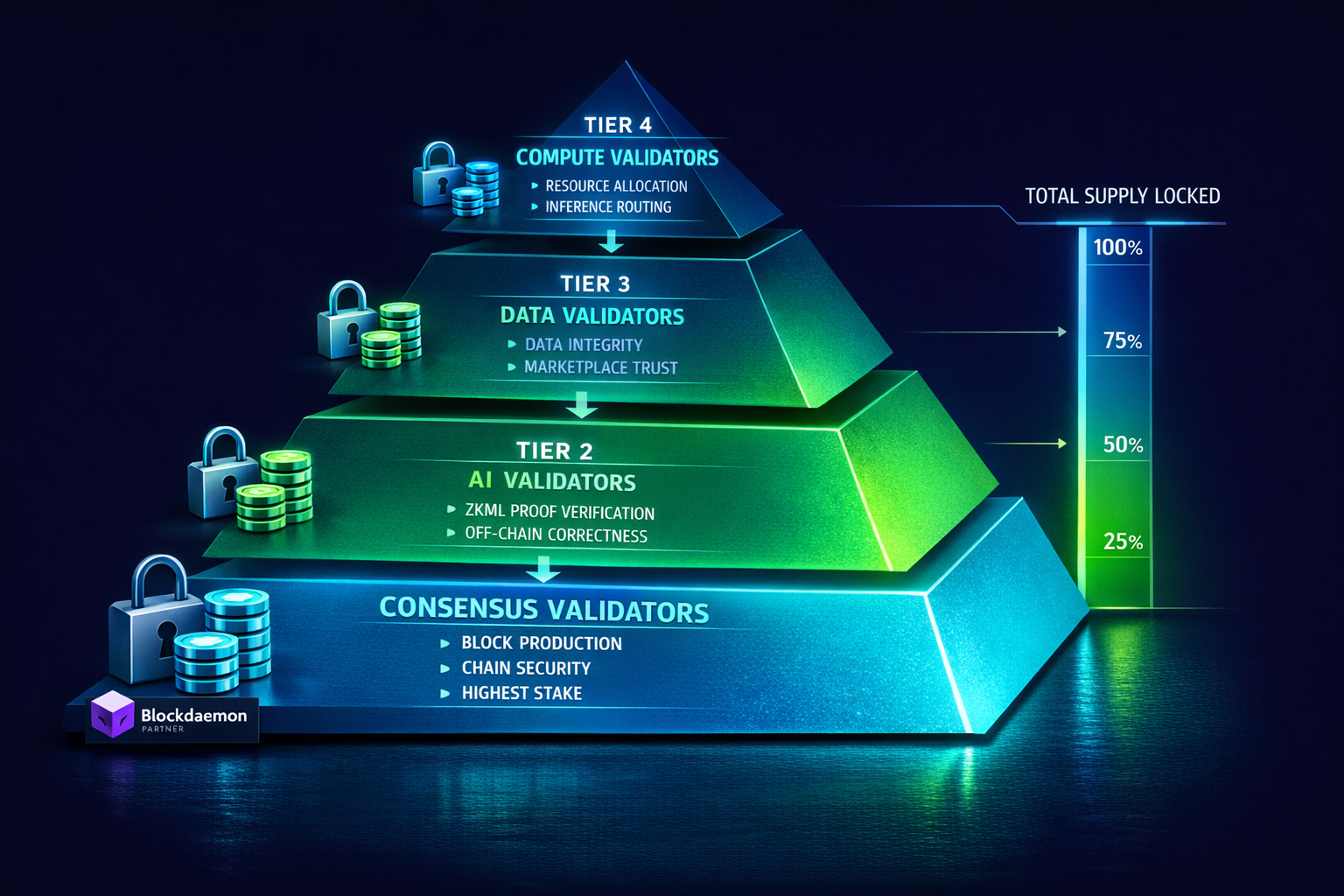
The Four-Validator Economy: Four Staking Sinks, Not One
Hierarchical diagram of four validator types showing distinct roles, reward profiles, and staking re
Hierarchical diagram of four validator types showing distinct roles, reward profiles, and staking re
AIVM's four-tier validator system is, to my knowledge, unique among both AI chains and general-purpose L1s. Each type has a distinct economic profile, and collectively they represent one of the most interesting staking architectures in crypto.
Core Validators
These are AIVM's backbone — standard Tendermint BFT consensus validators that produce blocks, validate transactions, and secure the chain. Economic profile: steady, predictable rewards from block production and a share of gas fees. Hardware requirements: standard validator infrastructure (Blockdaemon is a partner here for institutional-grade nodes). Staking requirement: likely the highest, given their role in chain security.
AI Validators
This is where AIVM gets novel. AI Validators verify that off-chain AI model executions are correct by checking ZKML proofs. This requires specialised knowledge of zero-knowledge proof systems and potentially specialised hardware for proof verification. Economic profile: potentially higher rewards per validator due to the expertise barrier. This is one of the most technically demanding validator roles in any blockchain — you're not just validating transactions, you're verifying mathematical proofs of AI inference correctness.
Compute Validators
These validators don't provide compute — they audit compute providers. They monitor GPU quality, verify that performance SLAs are met, and flag underperforming or dishonest providers. Think of them as the quality assurance layer of the compute marketplace. Economic profile: rewards likely tied to compute marketplace transaction volume.
Data Validators
Data Validators maintain the integrity and privacy of data flowing through the AI Data Marketplace. They verify that datasets are authentic, properly formatted, and that privacy constraints (ZKML + TEE protections) are enforced. Economic profile: rewards tied to data marketplace activity.
The combined effect: four distinct pools of $CGPT are locked away from circulation, each serving a different function, each with potentially different lockup periods and slashing conditions. For a token supply that's fixed and migrating (not newly minted), this multiplication of staking demand is one of the strongest structural supports for $CGPT value — if AIVM achieves meaningful validator participation.
Caveat: specific staking requirements, reward rates, and slashing parameters are not finalised. These economics depend on total staked supply, transaction volume, and fee structures that will only become clear during and after testnet. Anyone projecting specific APYs at this stage is speculating.
---
→
Four Validators = Four Staking Sinks
Each validator type locks $CGPT independently. As AIVM scales~ the aggregate staked-to-circulating ratio across all four tiers becomes a critical metric. Higher ratios mean less liquid supply and stronger demand fundamentals. Validator onboarding is happening now during the public testnet — early participation data will be one of the first real signals of AIVM demand.
07
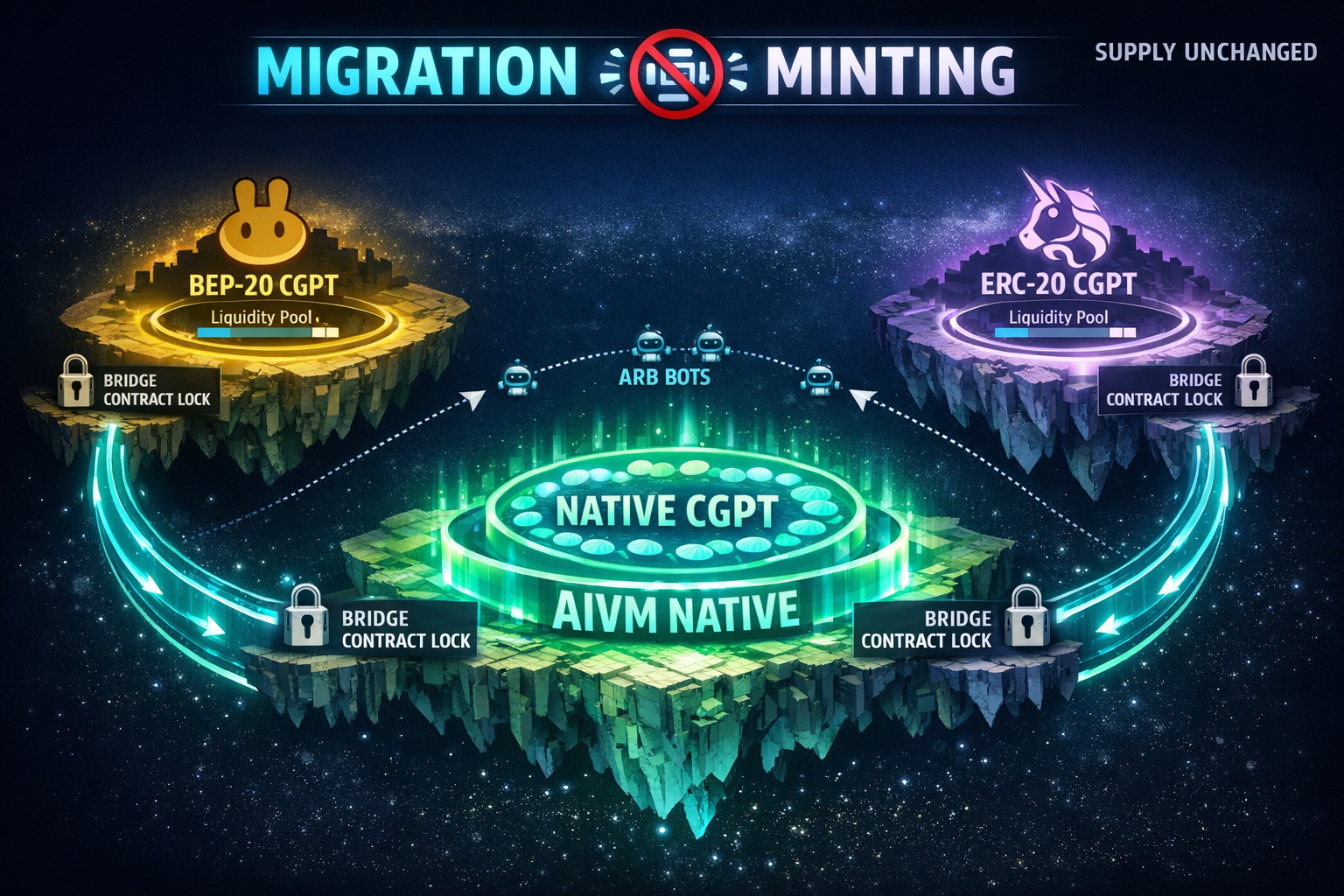
Supply Dynamics: Migration, Not Minting
Flow diagram tracing CGPT token migration from BNB Chain and Ethereum into native AIVM through bridg
Flow diagram tracing CGPT token migration from BNB Chain and Ethereum into native AIVM through bridg
Here's a nuance that matters enormously and is easy to miss.
AIVM is not creating new $CGPT. The migration from BNB Chain and Ethereum to the native AIVM chain is a relocation, not a dilution. The mechanism will likely involve a bridge contract: lock your BEP-20 or ERC-20 $CGPT in the bridge, receive native AIVM $CGPT on the other side. Total supply unchanged.
But the migration creates temporary complexity:
Liquidity fragmentation. During the transition, $CGPT will exist across three chains simultaneously — BNB Chain, Ethereum, and AIVM. Each pool has its own liquidity depth, its own DEX ecosystem (PancakeSwap and Uniswap for the existing chains, likely Cosmos-based or EVM-compatible AMMs on AIVM itself), and its own price dynamics. Arbitrage bots will work to keep prices aligned, but the fragmentation creates friction.
Exchange integration. Binance, KuCoin, ByBit, Gate.io, and MEXC will need to decide whether to support native AIVM deposits and withdrawals, maintain wrapped versions, or both. This is a non-trivial integration effort that typically takes months. Exchange support announcements will be a leading indicator of mainnet readiness and should be monitored closely.
The structural shift. Even with constant supply, the demand profile changes. On BNB Chain and Ethereum, $CGPT competes for attention in an ocean of tokens. On AIVM, $CGPT is the ocean. Every user, every developer, every validator, every AI inference — all require $CGPT. The same supply, with fundamentally expanded mandatory demand.
Whether the existing supply distribution (existing holders bought at various prices with various expectations) creates meaningful sell pressure during migration is an open question. It's one of the honest risks of the "warm start" approach.
---
08
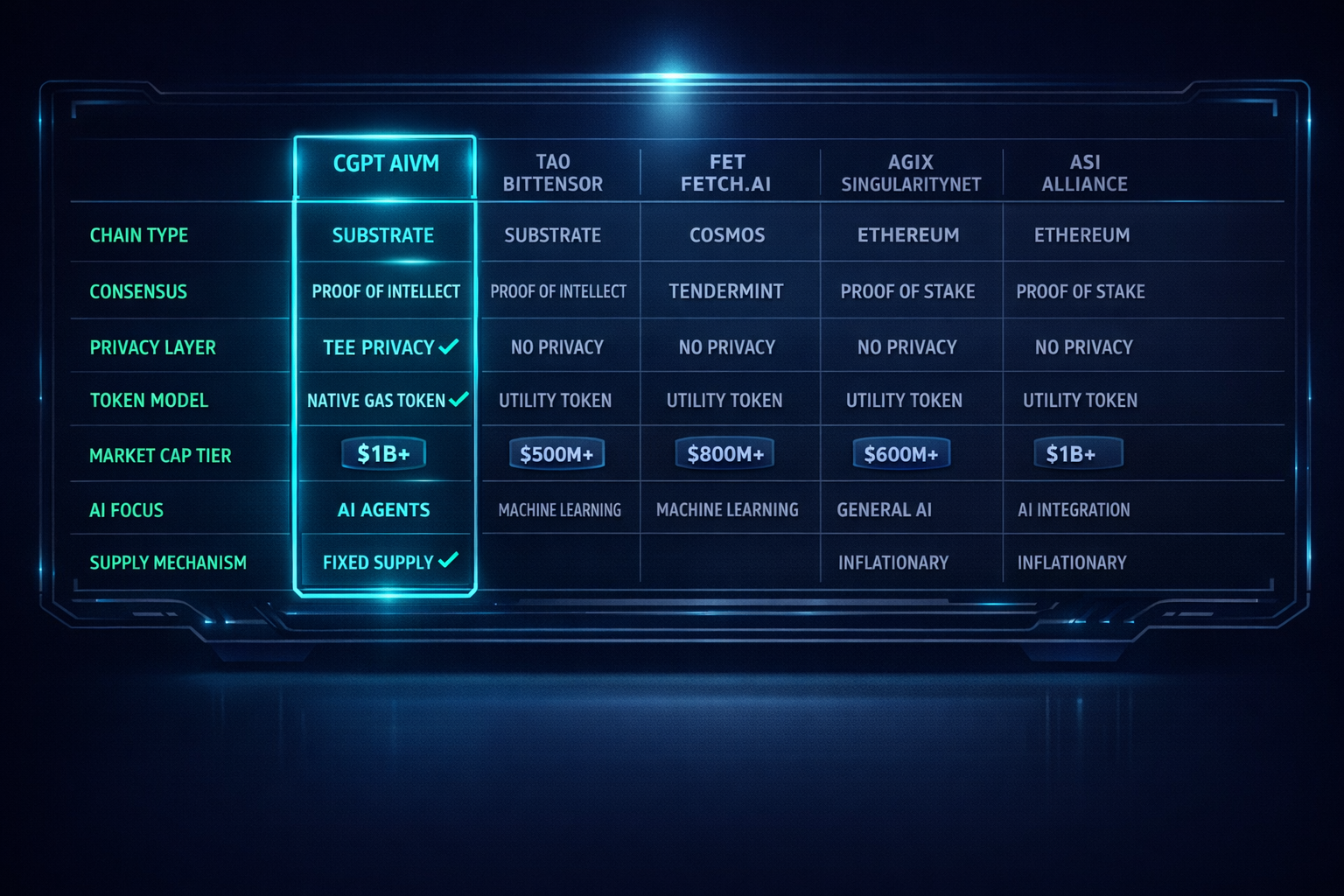
Competitive Landscape: $CGPT Against the Field
Structured comparison matrix of AIVM tokenomics versus Bittensor, Fetchai, SingularityNET, and other
Structured comparison matrix of AIVM tokenomics versus Bittensor, Fetch.ai, SingularityNET, and othe
Let's place AIVM's tokenomics in context. The crypto-AI sector has several established projects, each with different tokenomics philosophies.
Bittensor ($TAO) — ~$2.8B market cap. Bitcoin-like emission model powering incentivised ML subnets. Own L1 (Substrate-based). Mainnet live. Focused on ML model training incentives. No native privacy layer. Supply is inflationary with a halving schedule.
Fetch.ai ($FET) — ~$1.8B market cap. Powers an autonomous AI agent economy. Live since 2019. Now part of the ASI alliance (merger with AGIX and OCEAN), which is reshaping the competitive landscape significantly. Cosmos-based post-merger.
SingularityNET ($AGIX) — ~$1.2B market cap. AI service marketplace. Live since 2018. Operates on Ethereum and Cardano. Merging into the ASI alliance.
Ocean Protocol ($OCEAN) — ~$350M market cap. Data marketplace focused. Live since 2019. Compute-to-data privacy model. Also merging into ASI.
First, $CGPT is the only token attempting full-stack AI value capture — compute, data, model execution, validation, and consensus — through a single native gas token. Bittensor captures ML training incentives. Ocean captures data marketplace fees. Fetch.ai captures agent coordination fees. $CGPT aims to capture all of these simultaneously. Whether this breadth is a strength (unified value accrual, no leakage to other tokens) or a weakness (trying to do too much, diluted focus) is a legitimate debate.
Second, $CGPT is the only major AI token with native privacy infrastructure (ZKML + TEEs). This isn't a trivial differentiator. Privacy-preserving AI computation is one of the highest-value use cases in the entire space — healthcare AI, financial models, legal analytics, proprietary model inference — all require it. For many enterprises, privacy isn't a feature; it's a legal requirement (GDPR, HIPAA). If AIVM becomes the default chain for privacy-preserving AI, the $CGPT demand from this single vertical could be substantial.
Third, the ASI alliance (FET + AGIX + OCEAN consolidating into one entity) is a significant competitive development. Three projects that individually targeted different AI verticals are merging into a unified platform. This consolidation could create a stronger competitor — or it could be plagued by integration complexity. Either way, AIVM launches into a market where its competitors are actively restructuring.
The biggest structural advantage competitors hold: they're live. Bittensor's mainnet is operational. The ASI alliance components have been running for years. AIVM is in public testnet. In crypto, shipping matters, and AIVM hasn't shipped mainnet yet. Every month of delay is a month competitors extend their network effects.
---
09
Privacy as a Tokenomics Driver: The Underappreciated Angle
I want to dwell on this because I believe it's the most underappreciated demand driver in the AIVM tokenomics model.
ZKML proofs are computationally expensive. Running an AI model inside a TEE adds overhead. Data Validators monitoring privacy compliance cost resources. All of this means that privacy-preserving AI transactions on AIVM will command premium fees compared to standard, non-private transactions.
This isn't a bug — it's a feature, both technically and economically.
Consider the use cases where privacy is non-negotiable: a pharmaceutical company training models on patient data, a hedge fund running proprietary trading strategies through AI inference, a law firm analysing confidential documents with LLMs, a government agency processing classified data. These entities will pay significantly more per transaction for guaranteed privacy — and many of them are legally obligated to do so. Their demand is inelastic by regulatory mandate.
None of AIVM's major competitors offer a comparable privacy stack. Bittensor has no native privacy layer. The ASI alliance relies on inherited infrastructure from its component projects, none of which have ZKML capabilities. Ocean Protocol's compute-to-data model is conceptually related but architecturally different.
If AIVM captures even a modest share of enterprise privacy-preserving AI demand, the per-transaction $CGPT value could be an order of magnitude higher than standard AI inference fees. This is the kind of premium that moves aggregate token demand meaningfully.
The caveat: ZKML at production scale is still nascent. Proof generation times are improving rapidly but may not yet support latency-sensitive applications. The testnet will provide the first real data on practical ZKML performance within AIVM. Watch those benchmarks.
---
10
The Partner Moat: Infrastructure Partnerships as Demand Catalysts
Partnerships in crypto are often nothing more than a shared press release. AIVM's partnership roster, however, maps directly to the chain's functional requirements in ways that deserve specific analysis.
Nvidia provides GPU infrastructure. GPUs are the physical substrate of AI computation. Nvidia's presence signals that AIVM's compute marketplace won't rely on consumer-grade hardware — it has a pathway to institutional-grade GPU supply. Nvidia GPUs also increasingly support TEEs, directly enabling AIVM's privacy architecture.
Alibaba Cloud, confirmed in January 2026 for GPU marketplace integration, is potentially the highest-impact partnership for $CGPT demand. Alibaba Cloud operates one of the world's largest cloud GPU fleets. If that fleet becomes accessible through AIVM's marketplace — with payments flowing in $CGPT — the transaction volume could be enormous. A single large-scale enterprise client routing compute through this marketplace would generate more $CGPT demand than the entire current retail user base.
Google Cloud provides backbone infrastructure — reliability, uptime, scalability. For enterprise clients evaluating AIVM, seeing Google Cloud in the infrastructure stack is a credibility signal that matters.
Chainlink CCIP (Cross-Chain Interoperability Protocol) enables AIVM to serve applications across multiple blockchains. This is strategically important: it means $CGPT captures demand from AI inference requests originating on Polygon, Solana, Ethereum, Cronos, Hedera, and BNB Chain — all confirmed integration targets. Cross-chain demand aggregation could make AIVM the hub for multi-chain AI, with $CGPT as the settlement token regardless of which chain the request originates from.
Blockdaemon provides institutional-grade validator infrastructure, lowering the barrier for professional operators to run AIVM nodes.
Honest assessment: partnerships take time to generate volume. An announcement is not revenue. The gap between "confirmed partnership" and "meaningful $CGPT flowing through the marketplace" could be quarters or years. But the pipeline is real, and the infrastructure partners are not small players. They are the largest technology companies on Earth.
---
→
The Enterprise Demand Thesis
If one major Alibaba Cloud client routes a $10M annual AI compute budget through AIVM's marketplace~ that's $10M of annual $CGPT buy pressure from a single customer. Scale that across Google Cloud's enterprise relationships and Nvidia's hardware ecosystem~ and you begin to see why the partner roster matters more for tokenomics than any retail adoption metric.
11
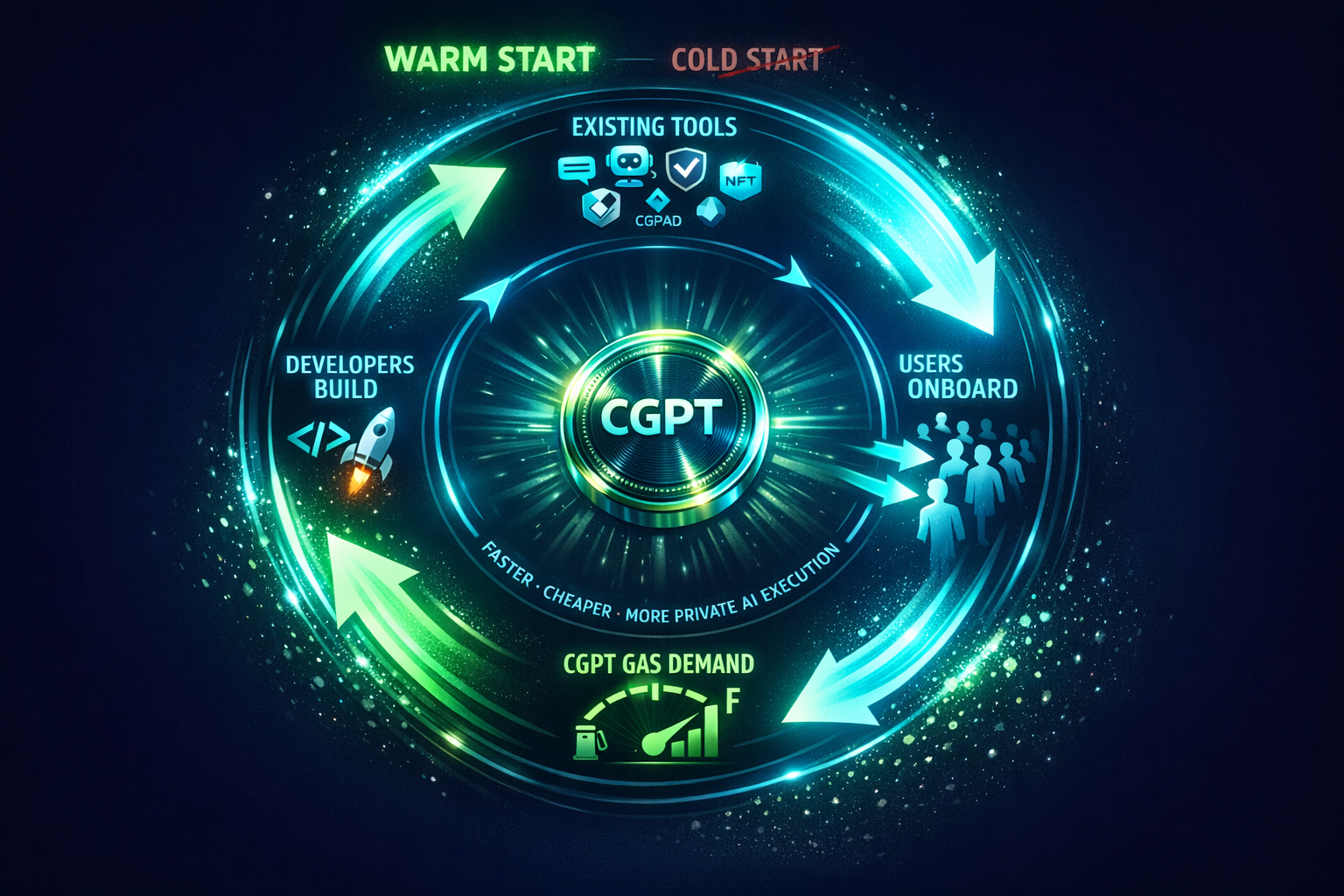
The Ecosystem Flywheel: Warm Start, Not Cold Start
Selfreinforcing cycle showing existing ChainGPT tools driving users, users driving gas demand, gas d
Self-reinforcing cycle showing existing ChainGPT tools driving users, users driving gas demand, gas
Most L1s launch with zero applications and spend years bootstrapping their ecosystems. AIVM launches with an existing product suite that already generates $CGPT demand:
The Web3 AI Chatbot serves daily users. The Smart Contract Generator and Auditor are used by developers. The AI NFT Generator creates digital assets. ChainGPT Pad has launched multiple IDO projects. CryptoGuard protects users. ChainGPT Labs incubates new projects that will build on AIVM. The open-sourced Solidity LLM attracts developer mindshare.
When these tools migrate to or integrate with AIVM, they create immediate demand for AIVM blockspace. The flywheel logic is straightforward:
Existing tools attract users → users need $CGPT for gas → AIVM offers faster, cheaper, more private AI execution → more developers build on AIVM → more tools attract more users → validator rewards increase with transaction volume → more validators stake $CGPT → more supply is locked → reduced circulating supply reinforces demand fundamentals.
This is a textbook token flywheel, but with the unusual advantage of starting warm. The 700K+ community, the existing product suite, the exchange listings — these are the kindling that's already burning. AIVM is the furnace being built around it.
---
12
Governance: Why AI Chain Governance Is Different
Cosmos SDK governance is real, binding governance. Proposals pass, code executes, parameters change. On most chains, governance votes cover gas fee adjustments, treasury allocations, and protocol upgrades. Important, but not existential.
On an AI chain, governance decisions carry weight that extends beyond protocol mechanics into AI safety and ethics territory:
›Which AI models are permitted to execute on AIVM? Can anyone deploy any model, or are there safety constraints?
›What privacy standards are enforced? How are Data Validators instructed to evaluate compliance?
›How are compute provider SLAs defined and enforced? What happens when a GPU provider delivers substandard performance?
›How is validator reward distribution balanced across the four validator types?
›Should the protocol have an inflationary component for validator incentives, or should all rewards come from fees?
These are not trivial questions. $CGPT holders voting on AI safety parameters are, in a real sense, participating in one of the first decentralised AI governance experiments. Whether governance weight will be based on staked, held, or delegated $CGPT — and whether validator types will have specialised governance roles — remains to be fully specified. But the architectural capability is there from day one.
---
13
Bull Case vs. Bear Case: An Honest Assessment
I want to be direct here. Both scenarios are plausible, and pretending otherwise doesn't serve anyone.
The Bull Case
AIVM mainnet launches on schedule in Q2-Q3 2026 with strong validator participation across all four types. The existing ChainGPT ecosystem migrates, creating immediate transaction demand. Alibaba Cloud, Nvidia, and Google Cloud partnerships drive real enterprise compute volume into the marketplace, generating substantial $CGPT demand from non-speculative economic activity. ZKML privacy features attract regulated enterprise AI workloads — healthcare, finance, legal — creating premium-fee demand that's inelastic to price. Chainlink CCIP integration makes AIVM the hub for multi-chain AI inference, aggregating demand from six or more major blockchain ecosystems. The four-validator staking system locks significant supply. AgenticOS attracts an AI agent developer community that builds hundreds of applications on AIVM. The ASI alliance's merger complications slow competitor consolidation. $CGPT's multi-exchange infrastructure and 700K+ community provide the warm-start advantage that no competitor can replicate.
The Bear Case
Mainnet delays extend into late 2026 or beyond. ZKML at production scale proves too slow or expensive for practical use, limiting the privacy premium thesis. Competitors with live mainnets — particularly Bittensor with its $2.8B market cap and operational network — continue building network effects while AIVM is still in testnet. The ASI alliance successfully consolidates FET, AGIX, and OCEAN into a unified competitor that captures the "full-stack AI" narrative before AIVM ships. Enterprise adoption of decentralised AI remains stubbornly slow — most enterprises continue preferring AWS, Azure, and GCP for AI compute because they're simpler, faster, and don't require crypto. Validator economics, particularly for specialised AI Validators requiring ZKML expertise, fail to attract sufficient operators, leaving the network underpowered. Existing $CGPT circulating supply creates meaningful sell pressure from holders who bought at different price points with different expectations and use the migration as an exit opportunity. Multi-chain liquidity fragmentation during migration creates pricing instability. And critically: the partnerships, while impressive on paper, take years to generate meaningful marketplace volume.
The Base Case
Somewhere in between. AIVM ships mainnet with modest delay, achieves meaningful but not explosive initial adoption, and begins the long process of building network effects. The partnerships are real but take time to translate into volume. ZKML improves iteratively. The competitive landscape remains fragmented. $CGPT's demand profile improves structurally from the gas token upgrade but depends on sustained execution over 12-24 months post-mainnet.
---
What to Monitor in the Next 6 Months
✓
Public testnet participation metrics (validator count~ transaction volume~ active developers)
AIVM economic activity is the critical variable. It's driven by: total AI inferences processed, compute marketplace volume, data marketplace volume, number of active applications, and cross-chain demand via Chainlink CCIP. More activity = more mandatory $CGPT demand.
Supply dynamics are defined by: total staked across four validator types, tokens locked in bridge contracts (BNB Chain/Ethereum ↔ AIVM), tokens held in exchange wallets versus on-chain, and any burn mechanisms. More lockup = less liquid supply available to meet demand.
Competitive positioning is shaped by: time to mainnet versus live competitors, privacy differentiation (ZKML + TEEs), partnership depth translating to actual usage, developer adoption rate (EVM compatibility advantage), and the ASI alliance's execution versus AIVM's execution.
None of these variables have definitive values today. The public testnet, launching now in Q1-Q2 2026, will begin to populate them with real data. Mainnet, targeted for Q2-Q3 2026, will provide the first production-grade dataset.
---
15
What Comes Next
The AIVM public testnet is live. The web app — including the AI Data Marketplace, Quest Dashboard, and Block Explorer — is rolling out. The GPU Marketplace SDK is being released. Validator onboarding has begun. These are the leading indicators.
Mainnet, planned for Q2-Q3 2026, will bring the AI Compute Resource Marketplace, cross-chain integration via Chainlink CCIP, and Oracle integration online. This is when the theoretical demand drivers become measurable economic activity.
The honest summary: AIVM's tokenomics architecture is one of the most thoughtfully constructed in the crypto-AI sector. The decision to use an existing, liquid, widely-distributed token as a native L1 gas token creates a structural demand upgrade that most competitors can't replicate without starting over. The four-validator staking system creates multiple, distinct supply sinks. The privacy premium from ZKML + TEEs is a potentially massive demand driver that no competitor currently matches. The partnership roster — Nvidia, Alibaba Cloud, Google Cloud, Chainlink, Blockdaemon — provides a pipeline from institutional infrastructure to on-chain economic activity.
But architecture is not adoption. Roadmaps are not results. Partnerships are not volume. The thesis is compelling; the execution is pending.
No official airdrop has been announced — any testnet participation benefits are speculative. Mainnet timelines are subject to change. This article is educational content and not financial advice.
The next six months will tell us whether AIVM becomes the infrastructure layer for decentralised AI or another promising architecture that couldn't close the gap between design and demand. The data points are about to start arriving. Pay attention to them.
---
$CGPT is available on Binance, KuCoin, ByBit, Gate.io, MEXC, PancakeSwap, and Uniswap. AIVM has been audited by CertiK and Hacken. The public testnet is live — validator onboarding and ecosystem exploration are underway at app.chaingpt.org.